


Saxophone & Gear Reviews


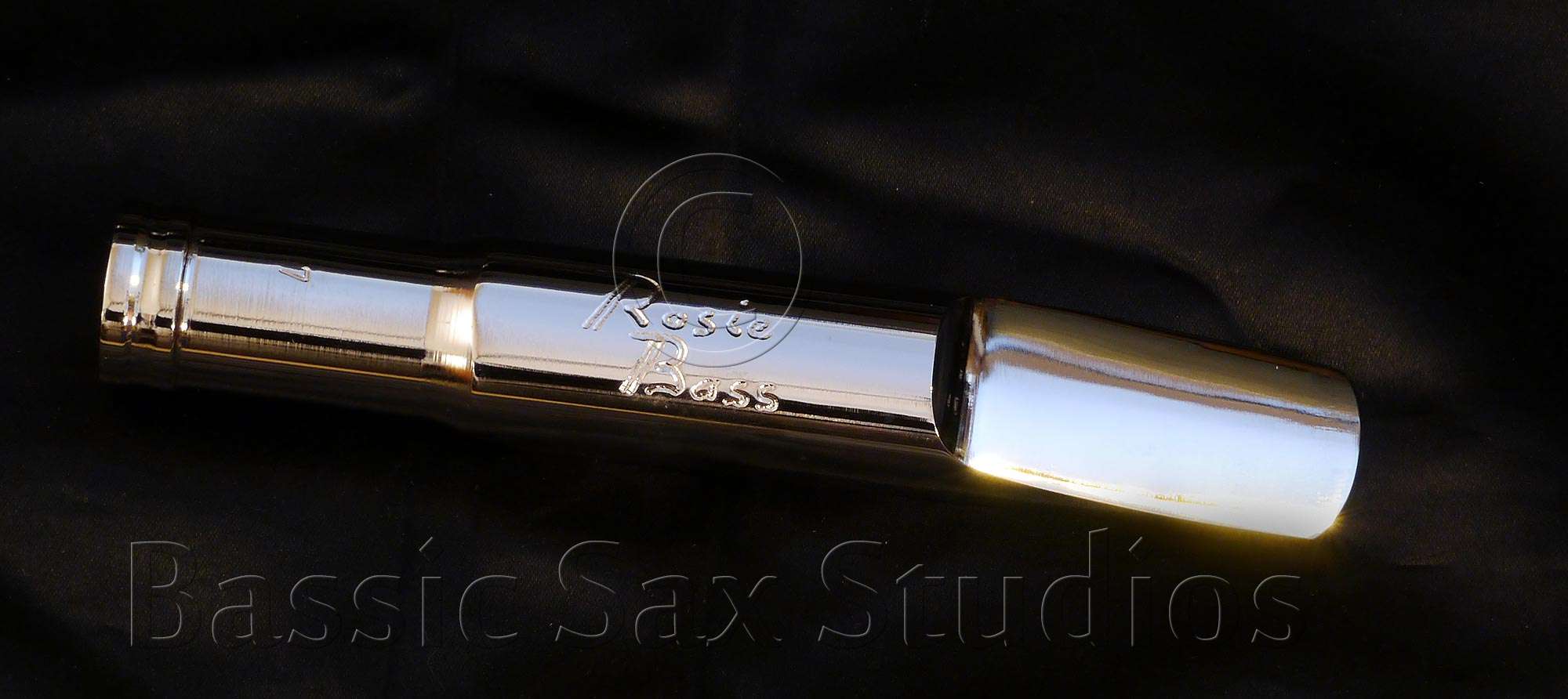
Fred Lebayle Rosie Bass Saxophone Sax Mouthpiece Rhodium Plated Size 7
Date of manufacturing: Circa 2023
Date of review: 2023/26
- I wrote the bulk of the review in 2023. However, due to Fred’s illness I put off publishing this at Brian’s request.
- I completed this review in 2026, with a different focus, since they are no longer in production.
Set-up 1:
- Jinbao-made Sakkusu bass saxophone (Selmer copy)
- Rovner dark lig
- Rico Bass Sax/Contrabass Clarinet Reed 2 1/2
Set-up 2:
- Herb Couf Superba 1 bass # 871XX
- Rovner dark lig
- Rico Bass Sax/Contrabass Clarinet Reed 2 1/2
- Fiberreed Bass Sax MS
- Legere Bass Sax Reed 2
- Fiberreed Bari Sax Onyx M
In the fall of 2023, I had the opportunity to play on a Rosie Bass saxophone mouthpiece for the first time. These handcrafted pieces came from the workshop of the late Fred Lebayle, and were available on a very limited basis through bass saxophonist, composer, performer, studio musician, and Berklee instructor, Brian Landrus.
Brian and I originally started corresponding through a bass saxophone group on Facebook, and he suggested I give the Rosie a try. I listened to his tone on his Selmer Series II bass, and despite knowing full well that I wouldn’t sound like this,  thought, sure, why not. I’m always up for trying out new gear.
This is how Brian described the Rosie in his eBay store at the time:
[T]his is a new metal Rosie model bass saxophone mouthpiece by master craftsman Fred Lebayle. This piece was handmade from a solid brass bar and then rhodium (platinum) plated. Lebayle pieces are completely handmade without the use of CNC, which gives a unique character to each pieces. Each mouthpiece has a unique serial number. They have a 18mm ID so they fit on Selmer bass saxophones. The Rosie Bass uses both bass saxophone and baritone reeds. I personally prefer the Rico bass sax/contrabass clarinet reeds, but others work well also. Many bass sax mouthpieces are made for baritone reeds, and I find it’s impossible to get as large of a tone with a baritone reed. The Rosie has a large chamber with rounded sidewalls to achieve a rich tone, while maintaining power from the vintage Otto Link-style rollover baffle. It has a large amount of power, and can also subtone beautifully. This is one of 15 Rosie bass pieces made this year. Each mouthpiece is handmade in Fred’s workshop in France and then shipped to me to be plated and distributed.
Shortly after talking to Brian about the piece, a Rosie 7 bass MP arrived on my doorstep. Timing was a bit crazy though, because this happened to be within a couple of days of me getting my new Keilwerth Shadow tenor, as well as a Bob Carpenter refaced Dukoff tenor MP. That meant I had A LOT of new gear to try and work on. (Additionally, I was trying to get my new JK & Dukoff under control enough so that I could use them on an upcoming Tenor 1 sub job I had in under 2 weeks.)
This overabundance of gear—and the steep learning curve on all of it—likely contributed to my complete lapse of memory, and total stupidity. I have been playing synthetic reeds exclusively since the late 90s, so apparently I had completely forgotten how long it takes a cane reed to break in.
Once the reed was broken in however, I really started to seriously like the Rosie bass MP—as you see in my first set-up review below.
The Rosie bass MP on a short wrap Sakkusu bass saxophone by Jinbao
I took the Rosie bass MP to my saxophone ensemble rehearsal and used the group leader’s Jinbao-made Selmer copy to try this piece. The Rosie bass sax MP’s bore is designed to fit the Selmer saxophones perfectly, and it fit this Sakkusu bass perfectly as well.
I used the Rico 2.5 bass sax reed and within 15 minutes—after the reed was broken in  —things were going along really well.
Response, Scale, & Intonation
- It spoke over the entire range. (Low Bb to high F#)
- Tuning was great over the entire range as well.
- The scale was even—well as even as this horn ever is.
- The only exception was D2. That note was a bit more on the stuffy side, and did do better when vented with the D3 key instead of the octave key.
My overall initial impressions & then some
I very much liked the piece, but I sound NOTHING like what I normally sound like on bass—and that’s not necessarily a bad thing. The Rosie paired with the Rico bass reed certainly provided a more flexible sound than my regular setup.
My regular bass sound is normally a really ballsy, take no prisoner tone that is great for rock, blues, jazz, Latin jazz, or anything where you want the bass to PROJECT. I did find that the Rosie didn’t project nearly as well with the Rico reed as my regular set up does. However, that could have also been in part the horn, since I’m not used to it, and I hadn’t spent any time comparing it with my regular set up.
The more I played the Rosie bass sax MP, the more I liked it. I liked it so much that I ended up buying it from Brian. I am very happy I did so, because as it turns out, mine was one of the last available from Fred before he had stop working due to health reasons.
I ended up playing Rob’s Sakkusu bass for 6 months, and used the Rosie MP exclusively. The more I used it, the more I was able to get out of the Jinbao-made bass. The MP is truly incredible.
The Rosie bass sax MP allowed me to develop a bass sax tone very different to what I normally have on long-wrap horns, but still clearly that of a bass saxophone. BTW, the myth that these short wrap horns sound like uber baris has already been disproven in the review I did of the Sakkusu. I wish people would stop perpetuating this  .
.
What I really, really liked
Beyond the tone and response, I very much liked the profile of the Rosie bass MP, and the feeling that it had in my mouth. It felt not much different than playing my Durga bari piece—despite the fact that it is clearly made for bass saxophone. It was just very comfortable to play.
The Rosie next to my other bass sax MPs
To give you a better idea of how slim the Fred Lebayle Rosie MP bass sax is, here it is beside my other 4 bass mouthpieces. It is by far and away the slimmest of all 5 of my bass sax MPs.


Rosie bass MP gallery


The Rosie bass MP on a long wrap Couf Superba I by Keilwerth
In short: It was a bust. I preferred, and continue to prefer, my Vandoren bass sax MP. Why? For a number of reasons:
The Rosie bass sax MP was originally made for Selmer basses
The Rosie bass sax MP’s bore is designed to fit the Selmer saxophones perfectly. Because of that, the cork on my Couf neck was not thick enough. I used plumbers tape to build up the neck cork enough to create an airtight seal. Had I liked the MP enough on the Couf, putting a thicker cork on the neck was certainly the way to go. However, that would have been a waste of time for me.
On My Couf Bass
- The D2 became as difficult to play as it was on my 1922 Buescher.
- It took a lot more air than my Vandoren, and my other choice: my Runyon bari blank modified specifically for bass sax.
- Given the amount of air the Couf requires compared to a short wrap horn, using a MP that requires even more air doesn’t make sense if I am not loving the tone/sound I can produce, and/or the response the horn has from it.
Reed stuff
- The fact that it is designed to only use bass reeds is a real turn off for me. Bass sax reeds cost significantly more than bari reeds, and quite frankly, I do personally not hear enough of a difference that should justify the cost. But hey, that’s just me. Feel free to disagree.
- I have been a synthetic reed player since the late 1990s. For bass sax, this gives me only 2 options: Légère Classic, and Fiberreed Natural.
- I am not at all a fan of the Légère Classic on any bass. To my ear they are the sonic equivalent to watching paint dry.
- I play Fiberreeds on all my saxes. So I took a chance and ordered 2 Fiberreed Natural bass reeds from Harry in Germany, but sadly neither was the right strength.
Harry Hartmann Fiberreed Bass Sax MS
The first time I tried this I thought the reed was too soft. However, the next time I pushed the ligature much further down and I would say that the strength was almost perfect. It might be interested in trying a M from Harry to see what it could do. However, given I personally didn’t like the Rosie bass MP on the Couf bass, I didn’t see the reason to spend the $$.
The good
Intonation over the whole horn was good. The Rosie MP was a good match for the Keilwerth-made, long wrap bass saxophone. By extension then, for vintage American, and vintage American style bass saxophones.
The bad
- The sound is not a punchy & ruckus as what I am used to from either my Vandoren, or modified Runyon bari piece.
- The Rosie requires a lot more air, which combined with my Couf, is simply too much IMHO. That said, I know of a few pro bass sax players who use them together with vintage Conn basses.
Conclusion
Everybody prefers different gear, and can get different results from the same gear. In the end this stuff is just a tool. It’s how we as artisans use them that matters.
For that reason I give the Fred Lebayle Rosie Bass Sax MP a solid 4 out of 5 star rating. If I had a short wrap bass it would be my primary MP. And while I may not have loved it on my Couf, those who play it on their Conns and Bueschers, love it a lot—and sound fantastic doing so.
If you ever come across one of these unicorns for sale used, I would say if it’s local to you, arrange for a playtest. If you have to pay in advance, be aware that they were around $600 US new IIRC. Not sure what they would fetch in the used market, since I don’t remember ever seeing one come up for sale.
And PLEASE, don’t bug Brian about them. He is obviously no longer a distributor for the brand, and has none for sale anymore.

