

Completely updated with new research and details: April 2026
The Dörfler & Jörka (D&J) pages of the original Bassic Sax continue to be some of the most frequently visited. Since I last updated the D&J section of my site in 2012, I have continued to collect data, and catalogue hundreds of saxes made by D&J.
With the launch of The New Bassic Sax, this seemed like the perfect opportunity see if there was any new research available through my German colleagues; catalogue some new names; collate all the data I now have; and finally, redo this entire Dörfler & Jörka section to make it the most complete anywhere. In any language. In any format. In short, if you are looking for info on these horns that were straight-up tonal copies of JK’s Toneking and The New King models, you will not find a more comprehensive source anywhere.

Intro
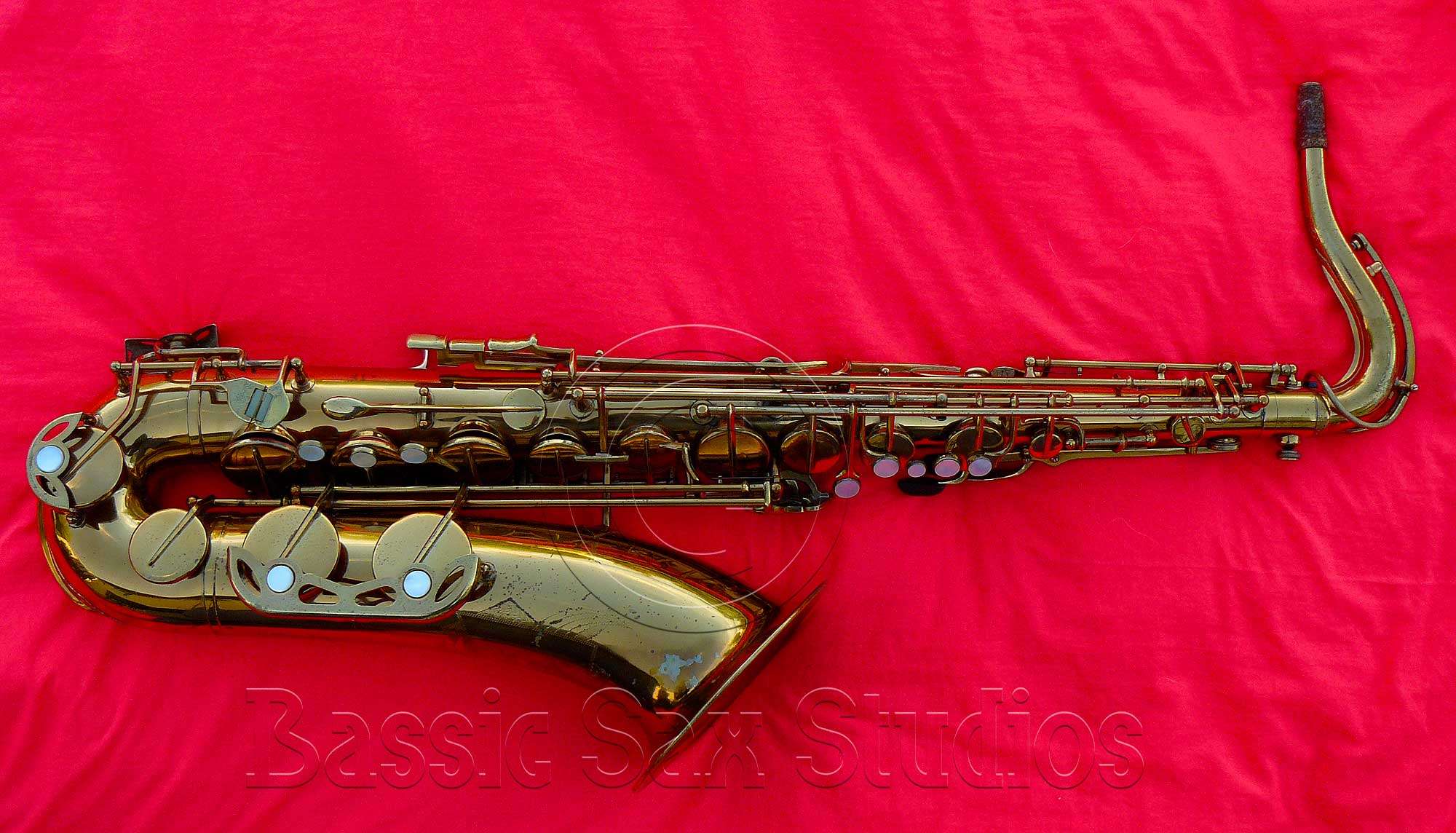
It was in early 2009, when I got my De Villiers tenor saxophone from Long & McQuade’s Abbotsford location that had just opened up its doors. In order to populate their brick and mortar store with stock, they brought in inventory from other stores across the country. Enter this oddity, from its Winnipeg location, that was in need of quite a bit of work. Most likely L&M had taken it in on a trade-in, but hadn’t touched it. This poor thing hadn’t likely seen the inside of a shop for for decades.
I got it for a smokin’ hot deal of around $450 Cdn, including any work needing to be done at the chain’s flagship location downtown. Couldn’t ask for better! I was thrilled, since I was at the time convinced what I was looking at was a stencil of Keilwerth’s The New King—a horn I had been looking for locally for quite some time.
As it would turn out, this rather unassuming tenor turned out NOT to be a JK stencil horn at all. Instead I’ve since started to call these Dörfler & Jörka (D&J) clones of the famous Toneking and The New King models.
Beginnings of my research
When I first began my research into D&J, there was almost no information about the brand available in English. The only person who had written anything about the horns was the late Sarge from WWS, who pointed out that they were connected to Keilwerth. In a SOTW post he also noted that a D&J tenor he did a custom repad on “smoked”.
Like I did so often in the early days of my vintage German saxophone research, I reached out to my colleague, Uwe Ladwig. Uwe is of course an author, saxophone historian, tech, and professional player who is perhaps best known in the English-speaking world for his German book: Saxofone: Ein Kompendium.
At the time Uwe had not yet written his first edition of the book yet, but had published an article on D&J for the former German music journal: Sonic Sax & Brass. With that article in hand I was off, and what follows here is the collated data of mine and Uwe’s research over the past 15+ years.
Company History
Main Highlights of D&J history
The full history is explained and illustrated below. But for now here are some key highlights to consider:
- PRIOR to founding D&J, Josef Dörfler and 2 associates worked for Julius Keilwerth, by attaching the keywork they had made according to JK’s specs, to the JK body tubes.
- When orders from JK declined, Josef Dörfler found a business partner in Hubert Jörka, and D&J was born.
- D&J operated in Nauheim between 1950 – 1968.
- During those 18 years D&J produced thousands of alto and tenor saxophones in their factory in Nauheim.
- These saxes were tonal copies of Keilwerth’s The New King & Toneking, but not exact physical copies.
- D&J made horns under a great many stencil names, but the horns are easily identifiable, and distinguishable from Keilwerth’s.
- D&J was contracted by Keilwerth to build the Selmer Bundy brand for the US market.
- Once he closed D&J, Josef Dörfler, was hired back at JK (he had worked for them in Graslitz already) where part of his duties included training Julius’ grandson, Gerhard.
So to be clear, D&J did NOT make Keilwerth stencils. They made tonal copies of Keilwerth saxophones, and sold them under their own SKY brand. Then they sold stencils by the thousands of their SKY models. Make sense?
Josef Dörfler & The J. Keilwerth Connection
Josef Dörfler, learned the trade of woodwind instrument making with clarinet maker, Franz Than, in Graslitz/Sudetenland, in Czechoslovakia. After he completed his training Dörfler went to work for Julius Keilwerth, who also had trained with Than. Julius Keilwerth had been producing saxophones under his own name in Graslitz since 1925.
After WWII, German speaking residents were expelled from Czechoslovakia. Like many German instrument manufacturers from Graslitz, the Dörfler family left via freight train in September 1946. At the time, each person was allowed to carry no more than 50 kg (approximately 110 lbs) of luggage.
The mayor of Nauheim, Germany, Heinrich Kaul, had let it be known that the city was open to receiving immigrants who could strengthen the local economy with production facilities. Julius Keilwerth had settled there as well, and soon Josef Dörfler began working for him again—mostly as a repair technician. At the time he did his work out of the laundry room of the Stelzer bakery in Nauheim.
Dörfler Strikes Out On His Own
In 1949, J. Keilwerth moved to a new facility, and Josef Dörfler decided to form his own company. On March 1, 1949, this new company was officially founded, located at Hügelstraße 21 in Nauheim.
At his new company location, Josef Dörfler, together with Josef Kühnl and Franz Hamm, did work for Julius Keilwerth. They would pick up Keilwerth body tubes and bring them to the shop. There they would attach the key work that they had built based on Keilwerth specs. Afterwards, the horns would be sent back to the Keilwerth factory where the saxophones were turned into the final product.
Dörfler & Jörka (D&J) Company History: The 1950’s
Due to declining orders from Keilwerth, Josef Dörfler, together with financier Hubert Jörka, founded Dörfler & Jörka, Saxophonherstellung (saxophone manufacturers) on September 1, 1950, and began manufacturing their own saxophones under the brand name SKY—which I have to date never seen even one example of interestingly enough. The Dörfler & Jörka plant was located at Steinstraße 18.
Jörka was the son-in-law of accordion and harmonica manufacturer Köstler. At the time Köstler was the most important and influential employer in Nauheim since they employed 300 townspeople. Jörka worked for Köstler as the company’s authorised signatory.
Dörfler & Jörka Saxophones
Features
D&J saxophones were remarkably consistent over their approximately 15 year production run. A few cosmetic things changed, but nothing of substance—well at least none in the thousands of images of horns we regularly see for sale or shown online. They were tonal copies of JK altos and tenors.
Here is a listing of D&J’s most obvious features:
Rolled tone holes
- D&J horns had drawn, rolled tone holes.


Round Thumb Screw
- A distinctive thumb screw that fastened the neck from the front. This same type of thumb screw was used on the Hohner President and Hammerschmidt saxophones. However, unlike the Hohner that had a double socket neck, D&J horns had a conventional neck and socket assembly.

Left Thumb Rest & Octave Lever on The New King Copies
- I have literally catalogued hundreds of D&J saxophones, and 99.9% of the horns are copies of JK’s The New King.
- The button is MOP, fake MOP, or on very rare occasions black plastic, and the octave lever was always teardrop-shaped.

Left Thumb Rest & Octave Lever on Toneking Copies
- Of the hundreds of D&J saxes I have catalogued, to date <5 have been copies of JK’s Toneking. (At the time The New King and Toneking were identical except for 2 extra keys that the latter had.)
- The difference is the shape of the octave lever.
- Note the round MOP key touch on the octave key. It was the same as we saw on certain JK horns of the same era.
- Gebr. Alexander Mainz alto # 12264, also happens to have been the first copy of a Toneking I had seen in over 15 years of researching this brand.

- Here we have a tenor with a round MOP octave lever.
- Note it has a black thumb rest, not MOP. It is also lacquered, not silver plated like the Gebr. Alexander Mainz alto shown above.
- ACe tenor # 17890, happens to be the first tenor copy by D&J, of a Toneking I ever saw.

Clothes Guard & Right Thumb Rest
- D&J made their clothes guards out of metal—like the replacement ones from JK.
- The right thumb rest for all D&J horns was a fixed, metal hook. I speak from personal experience when I say it was not nearly as comfortable as the one on the Toneking from the same vintage vintage.

Chromatic F# key
- This key is located on the side of the body tube.
- A fellow I met through my site years ago called the key shape a coke spoon-shaped F#. I never heard it described any other way, so I’ll go with it here.


Key guard Buttons
- Mother of pearl, or fake mother of pearl buttons (depending on what the ordering company requested) on the key guards, which while decorative and pretty, made it impossible to adjust the underlying felts for precise key height adjustments.
Right Pinkie Key Shapes & mechanism
- If the key shapes look familiar to you, it’s because they are the same as those we see on Keilwerths from the same era—not to mention other German horns since the 30s & 40s.


Matching Serial # on Neck
- D&J stamped their necks and saxes with matching serial numbers.


Made In Stamping
- I have so far documented 2 different Made in stampings.
- Made in Western Germany
- Made in Germany
- Additionally, I’ve catalogued a couple of D&J saxophones that have no stamping beyond the serial #.


Finish Options
Dörfler & Jörka offered the following 4 finish options:
* By far the least common of the hundreds of D&J horns I have catalogued.
Engraving
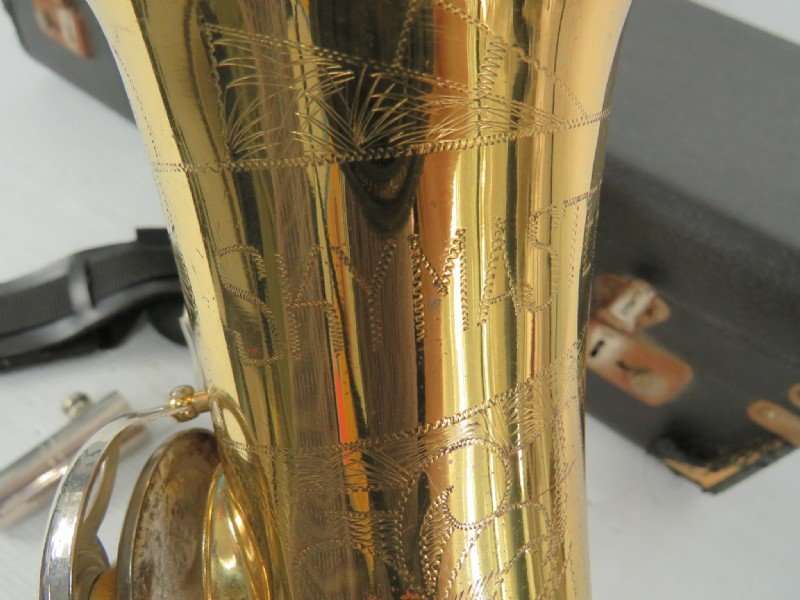
Given the hundreds of D&J saxophones I have cataloged, I am amazed how consistent their engraving was—given that 99% of the horns they made were stencils of their own SKY brand. The first horn in the gallery below, Senator tenor # 8746, shows the most common bell engraving very clearly.
Most common D&J engraving features
A mix of geometric and floral engraving which includes:
- What looks like a mountain range of 4 peaks at the top.
- A blank space or badge, where the name of the ordering company could get stencilled in.
- The rest of floral and geometric engraving runs the length of the bell to the bow.
Other elements found in D&J engraving
- In the following gallery I have included shots of all the various types of engraving I have examples of.
- I’m sure there are still others since I am still cataloging previously unknown—at least unknown to us sax researchers—stencil names even after nearly 20 years of cataloguing the brand.
Questions these engraving examples leave me with
- Did D&J sell saxophones to companies with a bare badge so that they could be engraved in house? If so, that might explain why some bell badges have a dull finish. EG: the U.S. Bandmaster alto in the gallery name below.
- If D&J did sell unbadged horns, could that explain some of the unusual names such as: SML and JK?
- Might that also explain why we see unstencilled D&J horns?
- Did these more unusual stencil names (JK, SML) really get ordered by the company with its name on the bell? Or were they just unstencilled horns that were engraved after the fact to make them more valuable by someone? Or was perhaps the original name buffed off, and then a different name engraved? Neither the JK nor the SML have stencil name engraving that matches the rest of the horn engraving. (In the case of the JK, it has body engraving that was clearly done recently.)


Stencil Names
First and foremost Dörfler & Jörka supplied saxophones to dealers such as Gebr. Alexander Mainz. The D&J saxes are stencilled with many names. To date, the ones I’ve either seen or heard about include:
- ACe
- Artist #3oo
- Boucet
- Bufon
- Carl Ludwig
- Carl Schiller
- Clinton
- Condor
- Convair
- De Villiar
- De Villiars
- Diamond
- Diplomat
- Gebr. Alexander Mainz
- H. Genet
- Impala
- Imperial
- Jean Baptiste (older ones obviously)
- John Burg Zürich
- Jubilee
- Julius Keilwerth (? maybe)
- Kaiser (some)
- Key Tone
- King Tempo (some)
- La Sete Professional
- Marcel-Doriot
- National
- Original Hopf Classic
- Original Hopf Virituos
- Paragon
- Pierre Maure Artiste
- Ravoy
- Rene Dumont (some)
- Rodgers
- Roxy
- Saxmaster De Luxe
- Sax-Master
- Schuler
- Senator
- Sky (D&J’s own brand name)
- Skymaster
- Skytone
- SML (some)
- Star Tone
- Symphonic
- Toneline Artist
- U.S. Bandmaster
- Unstencilled
- Voss
- Warner Concerto
Gallery of Badge Names
I have assembled a gallery of names that I have amassed to date that illustrates the various stencil names.




D&J Baritones
Although Dörfler & Jörka did not make their own baritone saxophones, they did offer them as special order through the company. According to both Uwe Ladwig and Günter Dullat 1, the body tubes came from a famous French saxophone maker.
In their Nauheim factory, D&J made the rest of the parts; assembled; engraved; and finished the instruments in-house. This would explain why the D&J baris look remarkably like their altos and tenors.
Dörfler & Jörka never offered soprano saxophones for sale.
Names on bari bell badges
Over the years I have not seen many D&J baris—circa 10 to date—and the names on the bell badges I have cataloged to date are:
- Clinton
- Dörfler & Jörka* (photos in bari gallery below)
- Rene Dumont
- Skytone
- Star Tone
* What’s especially interesting on this D&J bari is that it actually engraved Dörfler & Jörka, and not with the company’s brand name: SKY. It is so far the first and only D&J horn engraved with the company name that I have come across. It may also be noteworthy that it happens to be a very high serial #, and thus likely one of the last horns made by the company before it was taken over by Keilwerth.
Noteworthy features on D&J baris


Some Unusual Dörfler & Jörka Key Guards
- I have catalogued these key guards in only tenor saxophones, and only in horns in the 7xxx serial range.
- Altos with 6xxx have the now-well-known bell key guards fitted with MOP or plastic buttons.
- I have also documented tenors with #79xx that have the conventional D&J key guards.
- Why these unusual guards? Why only on tenors? Why so few? Why did they stop making them? Who knows.
Wire Guards
In the spring of 2011, I received a number of emails from owners of D&J horns in Europe whose saxophones looked a little different. The first email came from a fellow in Sweden who owned a Dörfler & Jörka-stencilled, Ravoy tenor with wire key guards. This horn was interesting for a whole host of reasons:
- It was the first Ravoy saxophone that I had seen that had been made by D&J.
- The horn was pretty darn minty.
- The sax had among the lowest serial numbers I’d ever documented: 77XX.
- It had wire key guards.

D&J’s Angel Wing
Just a few weeks after Kjell contacted me, I received an email from a fellow in Germany. He owned a Dörfler & Jörka-stencilled, Original Hopf Classic tenor, which had belonged to his father. His father bought the horn new circa1956, in Frankonia, West Germany. The sax had cost 600 DM! That was a lot of money at the time.
Like the Ravoy shown above, there were some interesting features about this D&J stencil horn:
- The condition of the horn was quite remarkable—tarnish not withstanding.
- The sax had among the lowest serial numbers I had seen for a D&J horn (75XX).
- It had a metal angel wing key guard that resembles the ones that JK produced as replacements for the original Lucite angel wing guards on the company’s Toneking and The New King models at the time. These synthetic ones were of course prone to breaking.
Since I was sent those photos of the Original Hopf Classic tenor, I have catalogued a few more angel wing guards on some D&J horns in roughly the same serial range.


Why did D&J use and then stop different key guards?
These angel wing tenors—along with Ravoy tenor and its cage wire guards—are real proof that Dörfler & Jörka did experiment with design during the course of their production run—at least in the key guard department.
One is left to speculate why Dörfler & Jörka changed their key guards. Did Keilwerth have anything to do with it? Were the angel wings just a little too much like those found on their horns? Did Keilwerth pressure D&J to change the key guard design?
Furthermore, at this point we can only wonder if D&J made changes that went beyond the cosmetics of key guards. For example, did they make changes to the body tube or neck areas of their horns?
Court Action and Horn Changes
Since Dörfler & Jörka was in effect straight up copying their horns, in the early 1960s J. Keilwerth sought a remedy in the courts. Keilwerth’s court action at the time concerned itself with the tenor saxophones. However, the court in Düsseldorf ruled against Keilwerth stating that copying of saxophones was allowed.
Despite their win in the courts—presumably in an effort to not anger J. Keilwerth—Dörfler & Jörka nonetheless changed the design of their tenor saxophones. They also changed the design of their alto, and from that period onward used the Martin as their model. 2 Both companies still wanted to work cooperatively with each other, and continued to do so. For example, Keilwerth hired D&J to manufacture Selmer Bundy saxophones for the US market.
2026 update
I did try to look up this court case. Unfortunately the court that presumably heard this case, does not have case reports/decisions online for anything older than 1999. It is quite likely that only hardcopy versions are available through the court itself. However, I will continue to poke around and see if I can find anything. If I can, I will update it here.
Company History and More J. Keilwerth Connections: The 1960s
Until the mid 1960s, D&J employed between 15-20 people who were responsible for all aspects of the company’s alto and tenor saxophone production. As previously noted, Dörfler & Jörka did offer baritone saxophones. However these instruments came from France as raw parts, and were finished in Nauheim. D&J never made or sold any soprano saxophones.
Due to declining business, Hubert Jörka retired on December 31, 1965. At that time J. Keilwerth took over the production machinery and some half-finished products. The only exceptions to this were the instruments in progress and other materials that were in stock that Dörfler still could sell to someone else.
On January 31, 1968 Josef Dörfler officially closed his business and began working for J. Keilwerth again. At the time, part of his duties included working as an instructor for Gerhard Keilwerth, Julius Keilwerth’s grandson.
Serial Numbers
The lowest known serial number for Dörfler & Jörka saxophones is approximately 5,xxx, while the highest is approximately 18xxx. The assumption that the serial numbers did not start at 1 is supported by Manfred Dörfler.3
German saxophone historian, Uwe Ladwig, put together a speculative serial number chart for Dörfler & Jörka saxophones while researching the brand for his book: Saxophone: Ein Kompendium. This is only a best guesstimate, and not meant in any way to be an official listing.
Year |
Serial Number |
1955 |
5,000 |
1956 |
6,600 |
1957 |
8,300 |
1958 |
10,000 |
1959 |
11,600 |
1960 |
13,100 |
1961 |
14,500 |
1962 |
15,500 |
1963 |
16,400 |
1964 |
17,300 |
1965 |
18,000 |
According to both Manfred Dörfler and Gerhard Keilwerth 4
- D&J saxophones with serial numbers over 18XXX can easily be explained because of the Keilwerth takeover.
- By the mid 1960s Keilwerth was building saxophones with serial numbers in the 50XXX range.
- The partially finished saxophones that Keilwerth assumed from its takeover of D&J that had not yet been engraved were given Keilwerth key guards and a traditional neck fastening screw.
- The D&J saxes that already had their engraving were then assigned a Keilwerth serial number.
It is worth noting that despite having amassed a catalogue of thousands of images of 1000+ different D&J and Keilwerth saxophones over the past 20+ years of saxophone research, I do not have 1 of these D&J-started, and JK-completed horns that I can positively identify as such.
1 Saxophone: Ein Kompendium 5th edition, by Uwe Ladwig, p. 174, and Faszination Saxophon: Der Saxophonbau Auf Beutschsprachigem Bebiet, by Günter Dullat, p. 229.
2 Although Uwe Ladwig mentions this in his book Saxophone: Ein Kompendium 5th edition, p.174, I have never seen a D&J alto, tenor, or bari—of any serial #—that doesn’t look like a JK horn.
3 Saxophone: Ein Kompendium 5th edition, p.176.
4 Saxophone: Ein Kompendium 5th edition, p.174.
