

Copies with Significant Differences
- D&J manufactured their own alto and tenor saxophones that were J. Keilwerth copies, but these body tubes and necks were not 100% identical.
- Dörfler & Jörka were in effect tonal copies of Toneking & The New King saxophones produced by Julius Keilwerth during the 1950s – mid-60s.
Keilwerth vs. Dörfler & Jörka Necks
D&J and Keilwerth necks are NOT interchangeable because the socket, and therefore tenon size, on the 2 brands is different. (This is further expanded upon—complete with more photos and other horns belonging to another player—on the next page.)
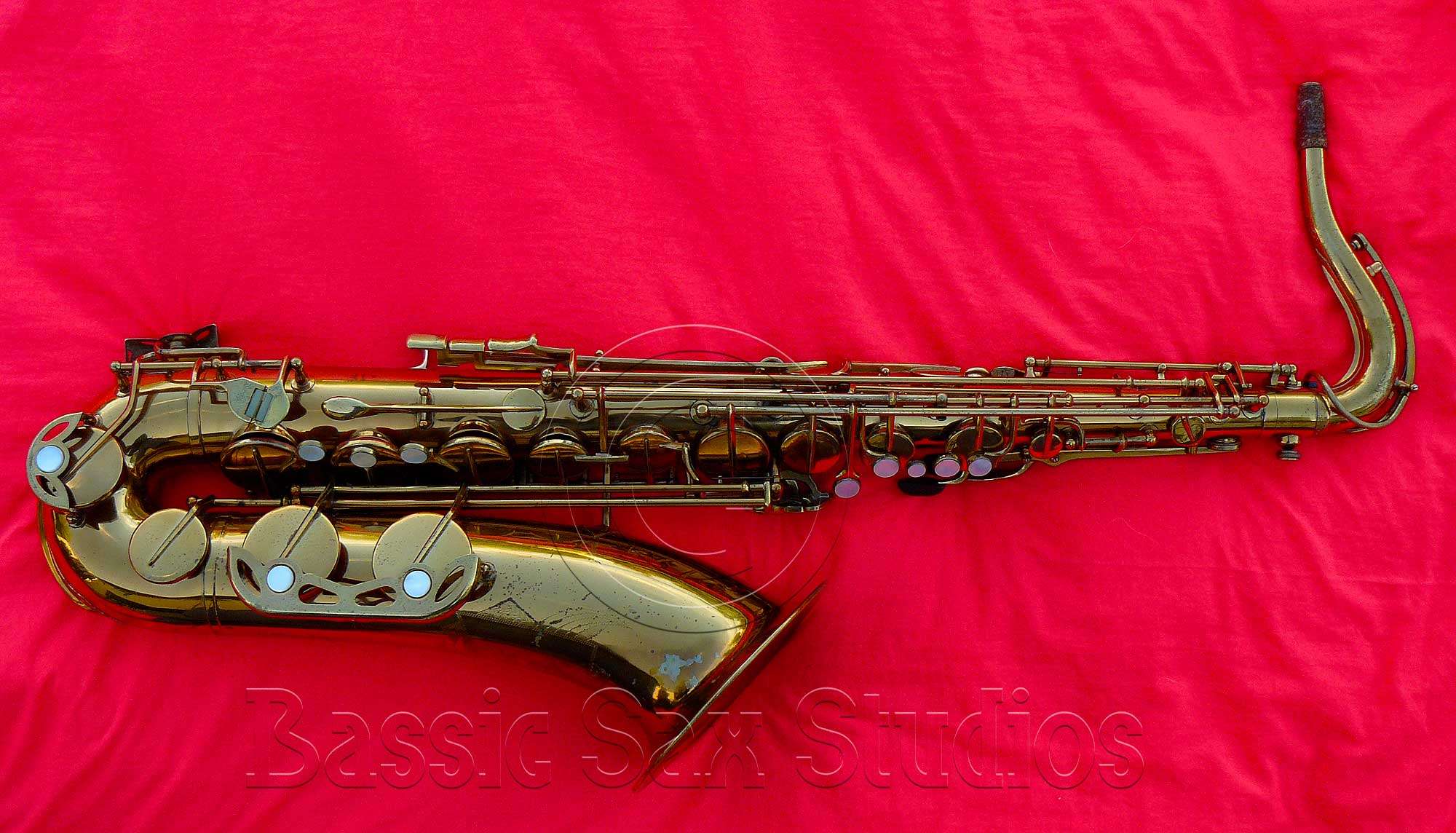
To illustrate this difference, back in 2009, I photographed my Toneking King # 29xxx, as well as my D&J-made De Villiers tenor #11xxx.
- The JK the socket is 27.82 mm.
- The socket on the D&J is 28.00 mm.
Not only is the socket size different, but so too are the necks on the D&J saxes. Years ago I had an email discussion with Palo, of the former Just Saxes website, about this very topic. This is what he had to say:
The D&J necks are different from Keilwerth’s. D&J necks have a VERY stuffy D2, in most cases, and the mouthpipe opening (not the tenon) of the neck is extremely small; I’m not talking about “extremely” as a technician’s term, which could be thousandths of an inch, but in terms of the naked eye. The tip opening on most D&J tenor necks is almost soprano-like in diameter.
As you can imagine, it doesn’t close down to that small diameter all of a sudden, rather the neck tapers down to it.
D&J’s may have some or many parts in common with Keilwerth, with different finishing, but the necks are different…
D&J tenors should not be considered equivalent to, say, a Toneking. The neck alone makes them very different.
While your experience may differ with regards to D2, as indeed mine does, Palo is correct about the mouth pipe opening. The opening is smaller on the D&J horns than it is on some other tenors.
Here is a photo that illustrates the differences in the openings of the mouth pipes in 3 of my tenor sax necks. They are from left to right: my Hammerschmidt, the De Villiers, and my stock Mark VI necks. Notice the De Villiers, in the centre, does appear smaller. But is it really?

If you really want to know what all these differences in neck tenon/socket, and pipe opening are over a number of D&J and JK saxophones, you can find all the gory details—complete with photos—on the next page.
Comparing/Contrasting Dörfler & Jörka & J. Keilwerth Saxophones
As you may have gathered from reading the previous page, there are strong physical—as well as sonic—similarities between D&J and Keilwerth horns. In order to accurately assess the physical similarities, seeing the 2 horns side by side is key.
Neck fastening screw
- Keilwerth used 2 types of neck fastening screws on their Toneking and The New King saxophones.
- For those with the angel wing, JK used a round thumb screw attached to a type of nose of sorts, that slid over the tenon. This could make for difficult tenon repairs.
- Once JK switched away from the angel wing to conventional key guards again—the same type they had used before the advent of the angel wing—the company used a conventional screw to secure the necks of their Toneking and New King saxophones.
- Dörfler & Jörka used a round thumb screw on not only their altos and tenors, but even their baris. This is the same type of neck fastening screw we see on Hammerschmidt and Hohner President saxophones.


Tone Holes
- The Toneking/The New King usually had rolled holes. (Although this changed in the 1960s).
- All Dörfler & Jörka altos and tenors had rolled tone holes.


Post Shapes
- Keilwerth post shapes changed over time. They started out the same as D&J: cone shaped, but at some point during this period JK changed the posts on the Toneking/The New King to what they still are today: 2 trapezoids staked on top of each other.
- D&J’s posts are all cone shaped.
- Fun fact: This post shaped is common in many saxophones from German speaking regions of Europe. Akustik, Hohner, Hammerschmidt, etc. etc. all had posts of this shape.
- Other fun fact: This cone shape has been the traditional style of German board game pieces for circa 100 years. Perhaps that was their inspiration?


Angel Wing key guards
- Keilwerth used a synthetic key guard on their Toneking and The New King saxophones in the 1950s.
- Keilwerth had their angel wing design patented in 1952.
- Due to the high breakage rates, JK came up with a metal replacement angel wing.
- D&J used a similar metal angel wing on a very few 7xxx tenors circa 1956. But as you can see, they look nothing like the Keilwerth ones.


Bell Key Bumpers
- Once Keilwerth switched away from the angel wing—in the early 1960s—the company used a conventional key guard for the bell keys. These guards had a screw-type adjustment for the felt, bell key bumpers, which allowed for precise adjustment of key heights on the Toneking and The New King saxophones.
- One of D&J’s distinguishing features is their use of decorative plastic or real mother of pearl buttons on the key guards. The felts are fitted for size on the bottom, and can’t be adjusted for height once fitted due to the MOP button top.


Pant Guard
- Keilwerths started out with a Lucite clothes guard. If these got damaged, metal replacements were available through JK.
- D&J used metal clothes guards throughout their entire production run. This was true for altos, tenors, as well as their baritones.


Key Shapes & Locations
Depending on whether the sax in question is a copy of Keilwerth’s Toneking or The New King, the number of keys would be different. The Toneking of course had a high F# key, as well as a G# triller. Below are some photos so you can see the models side by side for proper comparison.
Toneking vs D&J Toneking clones
In over 15 years of researching this brand, I have seen < 5 of these. Why? Good question. Maybe cost?


The New King vs D&J The New King Clones
I have cataloged literally hundreds of these D&J-made The New King clone horns. Key location and shapes basically didn’t change over the company’s production run.


But wait, there’s more!
The next page contains all the gory details about D&J necks vis a vis JK necks. Sockets and tenons are included as well of course.
Looking yet still more D&J info?
Given that I have spent the last 15 years cataloging Dörfler & Jörka saxophones and carefully comparing/contrasting them to the JK horns they are clone horns of, I would have to ask, why? What more could you possibly want to know? 
The research contained in these D&J pages was carefully compiled by myself and Uwe Ladwig. Then as a final confirmation, I consulted Günter Dullat’s: Fazination Saxophon.
If you are tempted are tempted to reach out to the Julius Keilwerth company, please don’t. Although JK assumed control of Dörfler & Jörka in the 1960s, the current J. Keilwerth company has no record of the serial numbers or stencil names that D&J produced. Contacting the J. Keilwerth company about your D&J sax will not net you any information.
I have created a Dörfler & Jörka Stencil Gallery. If you are interested in seeing more images of these unusual vintage German saxophones, make sure you check it out.
Note on sources: As noted in the footer of the previous page, the original research materials came from German saxophone historian, Uwe Ladwig. Uwe’s information sources were Gerhard Keilwerth and Manfred Dörfler, both of whom are from Nauheim.
I would like to thank Uwe for so generously allowing me to use his research, and very much appreciate the trust he has shown by allowing me to do my own translation.
The other source for some of the information I obtained was from an article about instrument makers in Nauheim, Germany titled: Die Entstehung der Musikinstrumentenindustrie in Nauheim. The article was written by Von Karl-Heinz Pilz, of Nauheim.
