
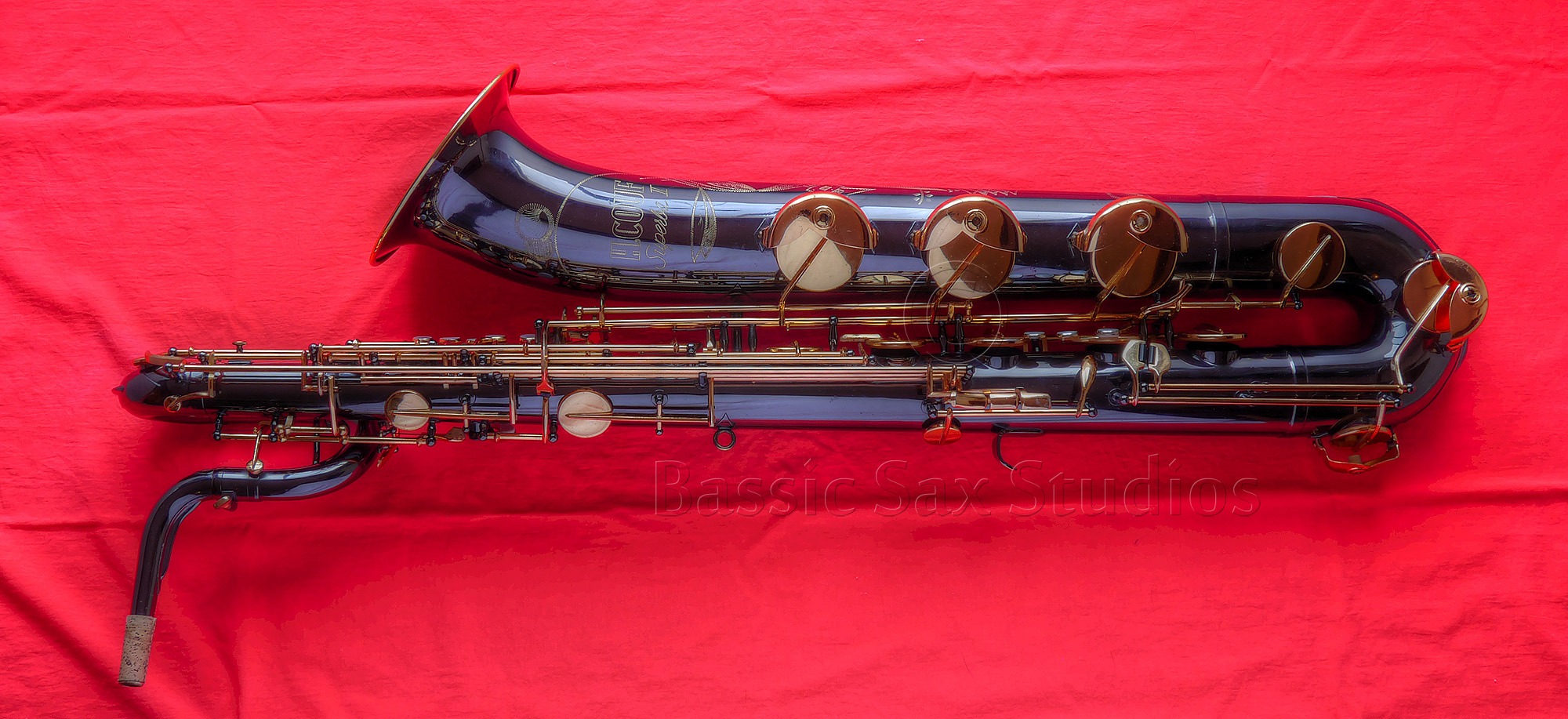


Updated July 2026
This post was originally inspired in 2013, by a thread on SOTW that got me thinking about a term that is bandied about so much, that it has basically become meaningless. The term vintage saxophone has been used to describe everything from 100+ year-old horns—which would really be considered antiques in the truest sense of the word—to modern horns with a faux vintage finish.
For this update in The New Bassic Sax, I have completely updated the article with:
- An updated definition of “vintage” saxophone.
- Provided a clear, 4-point check list of sorts to help make ID’ing one easier.
- Provided updated photos to show the differences between antique and new/modern “vintage”-inspired horns.
- Provided some clearer examples of what is and isn’t a vintage saxophone.
Introduction
I don’t know if vintage horns are falling out of favour these days with younger players. But if vintage saxophones are anything like vintage cars, I could postulate that many of their owners are getting up there in years and their horns are ending up on sales and auction sites.
Unrestored vintage saxophones often appeal to DIYers who want to learn how to repair or overhaul their own stuff. Whereas the higher-end, restored horns tend to find homes with collectors or players with particular tastes.
So with that as an intro, let’s take a closer at what is and isn’t a vintage saxophone.
What’s not vintage
A sax that is over 100 years old
- For example, this is my Evette & Schaeffer HP baritone from 1886. It is not a vintage sax. This is, in fact, an antique.

- Yup, by definition, most vintage American bass saxophones fall into this category as well. (This will not come as a surprise to anyone who has ever played one.)


Anything that declares it’s vintage, or has a vintage finish
Here are 2 European pro horn makers that really try to cash in on the vintage nostalgia in the saxophone market:
Julius Keilwerth SX90(R) Vintage everything from soprano through tenor
- Not only is the finish vintagesque, the model name is of course “Vintage”

Selmer Supreme alto
- Selmer’s latest offering in a vintage finish is the Supreme alto

Selmer Reference 54 tenor
- The Reference 54 tenor, is of course the model that started the company down the road of vintagesque-looking horns

What is a vintage saxophone? A working definition
This definition is a combo of one originally created by my friend and colleague Pete Hales, the man originally known as Saxpics, and myself. I took Pete’s and tweaked it to fit more of what I was seeing in the world of saxophone sales over the years.
There is a difference between “vintage” and “old”. When someone says they have a “vintage” instrument it should:
- No longer be in production, anywhere.
- Have been considered a professional, or semi-professional model when it was made.**
- Have value as a professional make and model today; as a playable instrument; or have value as a collectible make and model. EG: A HP Conn New Wonder alto Virtuoso Deluxe—the most expensive model there was with elaborate gold plate, heavily engraved, and full MOP key touches—is still “vintage”, even though it has virtually no playability value. (Although it is almost an antique these days, so I will soon have to come up with a different example.)
- Have maintained its original value—adjusted for inflation—or increased in value.
**This is in fact a bit more nuanced, and is described below.
If you think of it in car terms: A 1937, Mercedes Benz 540K Roadster is vintage. A 1972 Pinto is old.
In the saxophone world, think of it this way: A Martin Master or Keilwerth Toneking is vintage; a Bundy II or YAS-21 is old.
Examples of vintage saxophones
** In the golden days of saxophone manufacturing—in other words, before everything was outsourced to China or Taiwan—American instrument manufacturers had what was called a second line. In the case of Conn it was Pan American. These horns were still built to an extremely high standard, and have stood the test of time. They even had their own patent. They were not marketed as student model horns. Conn had the Cavalier models for students.
Pan American saxophones ranged a great deal in features and styles over the years, and some were pretty striped down versions. However, for the most part, many still meet the rest of criteria listed above, for vintage saxophones:
 They’re no longer being produced anywhere.
They were semi-pro instruments.
They still have value today as a playable instrument.
They have maintained their original value, adjusted for inflation, or in some cases even increased in value. (Think of Pan American bass saxophones.)
There are lots of other non-professional model saxophones that could be considered vintage. My favorite example to always cite is the The New King by Julius Keilwerth.
Even though Keilwerth considered it an intermediate model, the only difference between The New King with an angelwing and its more expensive, pro-model cousin, the Toneking, was the latter’s high F# key. Yes, the body tubes, key layouts, and necks were the same.
Mini gallery of fine vintage saxophones
Obviously this is a tiny gallery. I could have added hundreds more, but you get the idea.


Can stencil saxophones be vintage?
Yes. Yes they can, but they still have to meet the definition listed above.
Check out this article on what stencils are, and how they differed depending if they came from Europe or the US. And also how stencils were different from second line instruments like Pan American.
Common sense and knowledge is key
Think of vintage saxophones like this: one that has become recognized as exceptionally good at what it does.
If we keep the 4 criteria listed above in mind, this will prevent the floodgates from opening, and every subpar, or less-than-ideal saxophone ever built in the 20th century from being called vintage. Bottom line: there really has to be some common sense applied. This common sense has to be used by sellers, but more importantly, by potential buyers of vintage saxophones.
If a buyer doesn’t use their common sense, and some vintage saxophone-buying savvy, they’ll end up spending way too much money on a junker horn being sold as “vintage”.
Notice that I’ve purposely left out discussions of pre-1980, or other age-specific criteria. I know that 1980 is currently the common age cut-off for vintage versus modern horns. IIRC, this may have come from eBay.
I have also left out a discussion of features. Among other things, this takes away those endless and fruitless debates about whether or not Mark VIs are truly vintage saxophones. Let’s just say that they are, and move on.

Hi Helen, Hi All,
Thanks for this helpful article. I have often times engaged in this exercise, especially when I have been browsing saxophones on Craigs List. Legitimate musical Instrument stores / sax dealers seem to have a better handle on what is truly vintage …..and what is simply an old saxophone that should not command a premium price.
With that said, I was lucky enough to have found a buescher Model 157 tenor in original lacquer and very good shape on craigs list. Needless to say, this horn spoke to me as “Vintage” (and highly playable!) and I am now the proud owner.
For those of us in the Vintage horn market, hold out for the rare 1937 Mercedes Benz 540K Roadster , and don’t simply settle on. A 1972 Pinto!!!