


Updated July 2026
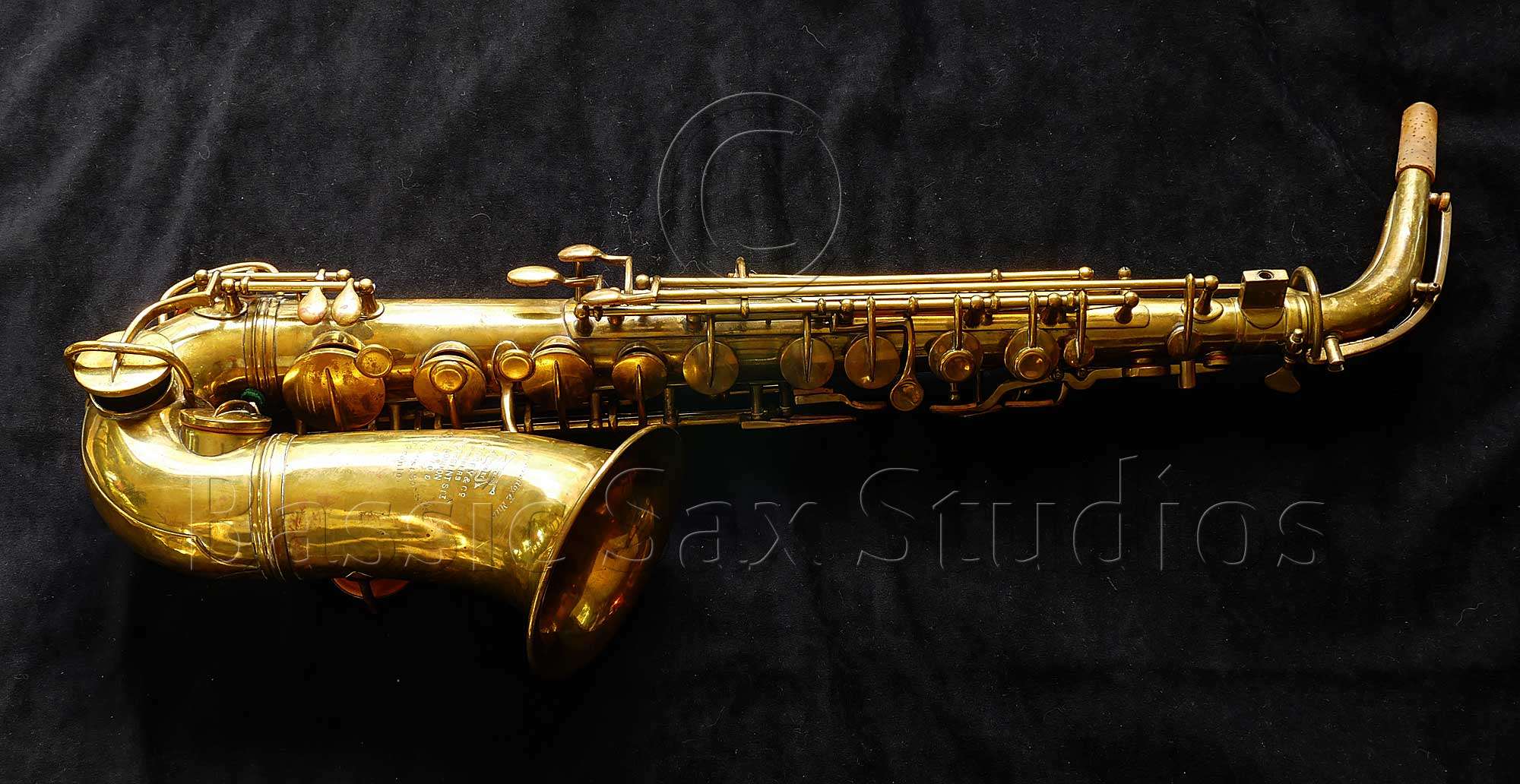
This is a combination of both of the articles from the original Bassic Sax Blog about this antique, low pitch (A=440), Boosey & Co. alto saxophone that is keyed to low B.
I want to thank Bill Gerber. Bill has been kind enough to allow me to keep this Boosey & Co. alto sax after it stole my heart. It became payment for arranging for the sale of another vintage sax that was worth considerably more.
Bill is a big supporter of music education, and it is through him that this horn will continue to be an integral part of music, and likely an inspiration for music students.
Thank you Bill!

For about 4 years, I worked PT for Matterhorn Music as the shop’s Education Rep—and whatever other odd jobs come along. Included in this list of odd jobs, was vintage saxophone identification.
Whenever odd, rare, or unusual saxophones came in, David called and let me know. Quite often I was asked to provide my expertise on the oddities, such as with this antique Boosey & Co. Eb alto with a double octave key mechanism.
Now without looking at any of the other photos included in this article, a couple of things should immediately pop out at you: the bell is too short, the right palm key configuration looks off somehow, and it has no rollers.
Internet research turned up scant amounts on saxophone production at Boosey& Co.
In total I spent the better part of a day researching both the Boosey Co. and their saxophones. What did I come up with? Very little I’m afraid.
I did however, find that in 2016, a woman in Australia had exactly the same horn—only in really bad condition—and was looking for information about it. She posted to all the same sax discussion boards that I have been a member of for 20+ years now. The information she was given should have been a warning to me, but I persisted because, well, I’m stur. 
A quick trip to the current Boosey & Hawkes website’s company history page tells us very little. It states Boosey & Co. was founded in 1792, when John Boosey opened up a lending library on Old Bond Street.
This family business stayed the course until 1850, when John Boosey’s great grandson—also named John—expanded the company’s offerings to become a purveyor of both music and instruments by manufacturing woodwind and brass winds. Then in 1930, Boosey & Co. joined with Hawkes & Sons to form Boosey & Hawkes.
Vintage sax specialists/players say what?
A couple of carefully crafted posts on popular saxophone discussion boards and Facebook groups added a bit more information, but sadly didn’t unearth a Boosey, or even a British saxophone expert who specialized in anything this old. However, a very useful post to my thread on the UK’s Cafe Saxophone forum, did provide me with a PhD dissertation on the Boosey & Hawkes company. (More on that below.)
I had hoped maybe well-known tech from England, Stephen Howard, might be able to shed some light on this mysterious horn. But alas, he could offer very little as well.
The fact is, these old-timers are simply just not of enough interest to saxophone players, techs, or even saxophone historians. Unless a saxophone this old was made by Adolphe Sax himself, it is simply an antique, and not worthy of attention, let alone restoration.
Lack of value aside, by this time I had invested too much time into a saxophone that wasn’t mine; was never going to be mine (little did I know ATT  ); and simply put, just wasn’t worth it. Therefore I decided I might as well make an article out of it to make it worthwhile, and hopefully someone else will find this research helpful down the road.
The history of Boosey & Co. and its saxophone production
As noted above, I was pointed in the direction of a PhD dissertation by Jocelyn Howell, titled: Boosey & Hawkes: The rise and fall of a wind instrument manufacturing empire. Chapter 3 in this dissertation is dedicated to Boosey & Co., and in it I did find some information that could be seen as helpful in the history of antique Boosey & Co. saxophones.
One thing I did note is that like their flute cousins, saxophones seem to be have been seen as other. They seemed to be neither fish nor fowl, and how Boosey & Co. categorized them is rather unclear.
There are dates given for when flute production started at Boosey & Co. (1856)1. When it comes to woodwinds, this is how they were described:
However, it is improbable that Boosé’s clarinets and bassoons were made in Holles Street as Boosey did not commence reed manufacture until 1879.2
Then a little further in the dissertation, we find this:
When B&Co. opened its factory at Frederick Mews in 1876, only the brass manufacturing operations from Holles Street and the newly acquired Distin business were relocated there. Flute making did not move from Red Lion Yard until July 1879; however, the workshop there was retained and continued to be used until around 1881. Reed instrument production commenced four months later with the first recorded order for a clarinet on 13 August. The 1892 catalogue states that ‘Boosey & Co. having for many years manufactured Brass Instruments and Flutes, determined, about twelve years ago, to complete their workshops by the installation of a Reed Instrument Department, in all its detail, for Clarionets, Oboes and Bassoons’. 3
It would appear that related to saxophones, Boosey & Co. took their first foray into saxophone production with the purchase of Distin & Sons in 1868.4 Boosey & Co. and the Distin & Sons relationship is described like this:
As demand for wind instruments and competition for military custom grew, Boosey took the opportunity to ensure a dominant position for their business in the British band instrument manufacturing industry. On 19 June 1868, they expanded their brass making business by purchasing the successful company Henry Distin & Co….
Distin’s company, a family firm, was established in 1845, at first selling musical instruments from their home in Manchester Street, Manchester Square, London and then in 1846 at 31 Cranbourn Street. At this address, from 1846–51, John Distin and his son Henry established Distin & Sons as a ‘Saxhorn Depot’, acting as the British agents for saxhorns, and from 1849, saxophones. In 1850 Henry took over the company, which was renamed Distin & Co., and within a year brass instrument manufacture commenced…
From 1862–68 the firm expanded into neighbouring premises, 10 Great Newport Street. According to Rose, by 1862 Distin had a workforce of 50 in their factory. Although primarily renowned for their instrument manufacturing, Distin were successful publishers of band music…
From 1868–74 Distin’s address was given as 9–11 Great Newport Street, after which the business was merged into B&Co. The acquisition of Distin marked the first significant growth of Boosey, enabling them to increase and develop their design and production of brass instruments. It is likely that until this time Boosey had acted mainly as dealers, as the entries of instrument sales noted in the stock books are to bands and other customers, with only a few to dealers. [emphasis added] Distin continued to be run as a separate company for the next six years, at first retaining the Distin name. Many instruments in the Distin 1868–74 stock books are documented as being sold to B&Co. and some from the Boosey books are detailed as sold to Distin & Co.Charles Boosey (1827–1905), John’s brother, took over responsibility for this department assisted by David Blaikley (see Appendix 2.ii) who was appointed Manager of the ‘Distin Military Musical Instrument Manufactory’ in 1873. In 1876 Boosey opened a new factory at 6a Frederick Mews, Stanhope Place near Marble Arch to which both the Boosey and Distin operations were relocated. This date corresponds with the discontinuation of stamping instruments with the Distin trademark of field trumpet with banner, [emphasis added] and full integration of product lines under the Boosey name. Boosey had also built 295 Regent Street in 1874 as their new headquarters and retail department, to which all instrument sales were transferred. 5
There is A LOT to unpack in this section, so let’s just grab the highlights:
- In 1868 Boosey & Co. bought Distin & Co.
- Distin & Co. (at the time named Distin & Sons) began as an importer of saxhorns.
- In 1849 Distin & Sons. became British agents for saxophones as well.
- By 1951 Distin & Sons had become Distant & Co., and began making brass instruments (saxophones are not mentioned).
- After the Boosey & Co. buyout of Distin & Co., each company operated separately under their own names for 6 years.
- The addition of Distin & Co. would have allowed Boosey & Co. to finally expand its own design and production of brass instruments for the lucrative military market.
- In 1874 Boosey built 295 Regent St. for their headquarters and retail centre.
- In 1876 Boosey & Co. open up a new factory that combined both the Boosey and Distin productions.
- 1876 the Distin trademark of a field trumpet with banner is discontinued, and the 2 company’s product lines are fully integrated.
Boosey & Co. was an exporter to “the colonies”. (And no, Canada is no longer a British colony. We adopted our own Constitution in 1982. If you research the rest of these you’ll note that most of them are no longer “colonies” either. )
Much of Boosey’s early export trade was to India and the colonies. Many orders in the stock books are recorded from administrations such as Bengal, Bombay and Madras in India, Victoria in Australia, or Canada and the Consulate of Siam. Colonial leaders who purchased instruments included the Maharajas of Jeypoor, Jheend, and Mysore, the Nizam of Hyderabad, Governor General of India,Viceroy of India, Rajah of Mundi and the Govenor of Bombay. Many other foreign regimental bands played Boosey instruments including some in Toronto, Quebec and Hong Kong.6
Where does this leave us re: sax production? With a lot of question marks. Questions such as:
- Does the alto in question have this Distin trademark? Or is it something else?
- Did Boosey & Co. consider saxophones brass instruments?
- Were saxes considered reed instruments?
- Or were they in a category by themselves?
- What Boosey & Co. serial # charts do saxophones fall into? We know they weren’t flutes. Woodwinds? Brass? Or something else that hasn’t been mentioned in any of the documents or company found so far?
- If saxophones followed the woodwind numbering charts, the Boosey & Co. low B alto’s year of production would be 1914.
- If on the other hand, saxophones followed the brass wind serial number charts, this Boosey & Co. alto’s date of manufacturing would be 1878.
I simply don’t know the answers to these questions, and this dissertation doesn’t make things any clearer.
The facts, and only the facts
While doing the research on this Boosey & Co. Eb alto keyed to low B, I came across a lot suppositions, theories, and assumptions. Fascinating, but not very helpful when determining what this thing really is. So let’s start with what we really know.
Bell Engraving
Approved by E. MillsTrademarkBooseyBoosey & CoMakers 295 Regent STTLondon20709The R.S. Williams & Sons Ltd. CoToronto

Features of this LP alto sax
- Keyed from low B to high F
- No pearls
- No rollers
- High E is directly above side Bb. Side C is located toward the front.
- It is built using ribbed construction.
- No bis Bb
- No front F
- There is no automatic octave key.
- Pads, corks, felts, and and at least some springs done in recently.
- Tone hole repairs evident
- When paired with my standard Meyer alto MP, the horn played 100% in tune over its entire range according to my Yamaha TD-1 tuner.


- The current owner bought it in its current state.
- Its case looks new, and is described separately below.
Assumptions based on what I’m seeing, hearing, and feeling
- Given that this Boosey & Co. Eb alto plays 100% in tune over its entire range with my standard HR Meyer alto MP, it would only make sense that it is indeed a low pitch (LP) horn tuned to A=440.
- The double octave mechanism indicates that it is a very early horn. I estimate it circa 1880s-1920s. (Remember Boosey & Co. amalgamated with Hawke & Sons in 1930, so it will pre-date this.)
- This horn was well taken of for its 100+ years. Whoever owned it most recently, cared enough about it to spend money [why?] on what looks like at least a partial overhaul.
- These Boosey & Co. saxophones are not too common, and again I have to ask: Why?
- Why have not more turned up in attics, basements, and garages?
- Did Boosey & Co. not make many saxophones?
- Were they not a big seller? Over the years, the following have popped up on the radar screen for me:
- The first was the previously mentioned, identical alto (#17222), which was an export to the R. Correll music store in South Australia.
- While the second (#17102) was shown as sold on an auction site in the UK in 2013.
- A third (#23591) turned up on a vintage saxophone group on Facebook group when I did this research.
- Another member of SOTW posted pics of a nickel plated alto they had (#22235) that was a wall hanger.
Educated guesses
- There are elements on this sax that give off a French feel. EG: the key guard feet strongly resemble those we see on Pierret. Is it possible that these early Boosey & Co. saxophones were stencilled for the company by a French saxophone manufacturer? Maybe.
- Or did Boosey & Co. perhaps get parts from French companies and assemble these at their factory? Again, maybe.
- Or perhaps these Boosey & Co. saxes were simply French-inspired.


- If this LP, Boosey & Co. Eb alto, keyed to low B was in fact not a stencil, then the 2 serial number charts previously mentioned leave us with a 36 year gap. (1878 brass wind production vs. 1914 woodwind production).
- When I originally saw the horn, I guesstimated its production date in the range from 1880-1920.
- According to my colleague, Pete Hales, who knows his way around vintage saxophones:
…a few manufacturers in Europe kept the “old style” Adolphe Sax-looking instruments around until the 1940s and sold them as their “introductory” saxophones, but sometimes with small improvements — like how your horn is keyed to altissimo F, rather than a more traditional Eb. It probably doesn’t have an automatic octave key, but that invention was patented in 1888 and a lot of makers charged extra for that. (I’m remembering $5 in one of the old Conn catalogs, for some reason. That’s about $125, adjusting for inflation.)
- Orsi and Pierret are 2 brands that immediately come to mind that had low B horns. Then of course there are the Martin Home models with their limited key work, and the Buescher Academy saxes aimed at the student market.
- However, to me this Boosey & Co. alto does not look like a beginner’s horn for the student or home market. It was likely built prior to there being a push for less expensive, student horns.
Remaining pic for consideration


Conclusions about the horn
So what are we left with?
As my colleague Stephen Howards says:
I don’t really have much to say about the old Boosey.
Horns that old (down to low B, double octave keys) tend to fall below the radar – unless they’re original Adolphe saxes.
No-one really wants them, and they’re not worth much more than scrap value (or ‘wall-hanger’ value).Source: cafesaxophone.com
I think that really the take away from all of this is:
- There are a lot of really old, definitely even antique, and arguably historic, saxophones floating around out there. However, just because something is old, that doesn’t make it intrinsically valuable.
- In your mind you may have a really unique and fascinating antique saxophone. Great. Enjoy it. However, don’t necessarily expect anyone else to pay you what you think it is worth.
- Used, modern and vintage professional Selmer models sell for <$3000. I should know. I just bought one. You can pick up a beautiful, unrestored Keilwerth Toneking Series III with an intact angelwing for around $1,000. Both Selmers and Keilwerths are brands that are suited to play in today’s settings. An antique, regardless how wonderful its condition, simply is not.
Compare/contrast to the familiar
I thought it would be interesting to compare this Boosey & Co. alto with its more modern, Selmer S80 Series I cousin. Despite being shorter in length, it still plays in tune at A=440. This I find rather strange, given my previous experiences with shorter horns. [Articles about the Max Keilwerth Globemaster Luxus coming]


It was well-cared for
Unlike so many antique horns, this little alto is in remarkably good shape. It has been care for very well in its 100+ history.
Before the previous owner got it, someone spent quite a bit of money on this horn. Why? I can only speculate that it was likely a family heirloom of some kind. I can’t think of another reason why anyone would drop the coin necessary to overhaul an antique saxophone that isn’t an Adolphe Sax original.
Not sure where this custom case came from, but someone even made the horn its current case from what I can only presume was a sample case from Philippine-based, La Tondeña Distillers Incorporated.
Based on the branding on the case, it comes from the period when San Miguel Corporation had a 70% stake in La Tondeña Distillers, and ran it under the name: La Tondeña Distillers Inc. Hence the case is from sometime during 1987-2003. How this sample case ended up in North America, and made its way into a saxophone case is also a mystery.


What happened with this Boosey & Co. alto sax?
This quirky horn stole my heart in a strange way due to its ability to play nicely in tune, as well as its features—or really, lack of them.
My studio has become home to a whole set of strange and wonderfully oddball saxophones. Over the years some real oddities like the:
- J.R. Lafleur & Son Varsity, which is a copy of the rare A.K. Hüttl saxophone.
- The SAIIIM soprano that doubles as a Christmas tree in the living room, and the
- Gallotone tenor that is almost a mirror copy of my Orsi tenor, but not quite. It was made using parts from both Orsi and R&C parts.
The oldest saxophone I owned before this baby officially became a Bassic Sax family member, is a Buffet-Crampon (Evette & Schaeffer) HP baritone from 1886. And just like that French-made bari, this British-made alto is nothing like the saxophones made today—or even the vintage saxophones people spend big $$ on.
These horns from the late 1800s simply sound different. They are not your grandfather’s saxophone. Simply put: They are Adolphe Sax’s saxophones. They sound the way Adolphe Sax built his saxophones to sound. And for the most part, they do not fit into modern orchestras, dance bands, or even community bands. They are simply different: Very different.
Even my circa 1930 Pierret sounds modern compared to this Boosey & Co. alto. As previously mentioned, when paired with my vintage Meyer MP, this Boosey alto plays perfectly in tune. What does take some getting used to is its double octave keys; lack of bis Bb; lack of front F; and oh yah, lack of low Bb. 😉 😆
The future for this Boosey & Co. alto
On occasion I do presentations on the evolution of the saxophone. The first time I did such a workshop I demo’ed 15 saxes at the Vancouver Art Gallery, with my Buffet baritone being the oldest. However, with it being a HP horn, it really didn’t demonstrate the tone as well as something that is tuned to A=440.
This Boosey & Co. alto demonstrates really well not only how the design of saxophones has evolved, but how the tone has sound has changed since Sax’s day. What we are hearing as an alto sax today, is nothing like what it used to be.
This type of presentation/concert is something that could be useful as workshops for schools, teachers, and for museum and gallery events.
Interested in finding out more? Live in Metro Vancouver? Reach out to me to inquire about availability, pricing, logistics, etc.
______________________________________________________________________________________________________________________
1 page 55
2 page 54
3 page 60
4 page 56
5 pages 58-59
6 page 59
Sources to explore if you’re looking for info on Boosey & Co. and Boosey & hawkes
Serial # list on Horn-u-copia (as stated, unclear if this includes saxophones or not)
PDF: A Guide To Dating Boosey & Co./Boosey & Hawkes Instruments Based on Serial Number
PDF: Brasswind Manufacturing at Boosey & Hawkes, 1930-59, by Arnold Myers
