


Updated July 2026
I was having an interesting conversation on a sax discussion board the other day about my new SX90R Shadow tenor. A bunch of us were kicking around moving from vintage to new/modern horns.
A member of the forum pointed out that in addition to the good ergos of new horns, he preferred the lack of regular maintenance and repairs that his new horns required, when compared to vintage horns.
I pointed out that I am not in any way becoming a new horn, or even a modern horn player. Other than my brand new Shadow, my next newest horn, is my Couf Superba I bass from 1983, which is of course a Toneking Special stencil.
My brand new Shadow notwithstanding, I have played vintage saxophones for almost my entire saxophone-playing career. And while some of my now-vintage horns weren’t quite vintage when I first got them back in the 80s, they were in fact used.
Fast forward to today, and 22 of my current pro horns (saxes and 3 clarinets) that are ready to go out on jobs with me on a moments notice, are vintage. And other than the Shadow I just got in September, all the new-to-me horns I acquired over the past 20 years and use(d) regularly, are vintage—or in some cases even antique (meaning they are over 100 years old).
How do I maintain my horns in a gig ready state?

After working as David’s Educational Rep for over 4 years, I can unequivocally state that my vintage horns do NOT require more maintenance or repairs than new or modern horns do. There were lots of customers who brought their new or modern horns in far more often than I did.
If you wonder why that might be the case, I believe there are many reasons for this. No doubt part of it has to do with build quality. Bad quality horns will require more work from the get, and throughout their lifetimes.
Not to minimize build quality, but that really is only one reason why my vintage horns don’t land in the shop as often as some others might. Another reason would be because I regularly maintain them by doing the following. (I did these things long before I worked for David, and continue to do so—even though I stopped for him in April.)
Regularly
- Don’t eat before or during playing without brushing my teeth.
- Don’t drink anything other than water while playing, without brushing my teeth.
- Oil the horn’s keys, screws, and rollers regularly depending on its use. For horns I use very little, that could be as little as once per year. For horns I use all the time, it could be twice a year. But don’t over-oil!
Annually
- Take the instrument to the tech for a through check up; maintenance; repair/replace what needs to be done.
Bottom line: If you don’t maintain your horn, it doesn’t matter how new or old it is, like any mechanical item, it will break down.
At time of purchase
- Get it overhauled*

More often than not I get a new-to-me instrument overhauled at the get.
*Sometimes a horn doesn’t need a full overhaul, but only what David and I refer to as an overhaul light. (We did this on my closet Couf bari and bass.) In this case the horn is not cleaned in a chemical tub, and not all the pads are replaced. However, the rest of the standard overhaul steps are still followed:
- Complete disassembly
- Complete inspection & cleaning of all parts
- Everything oiled & greased
- Necessary pads replaced
- All corks and felts replaced
- Any loose key work tightened
Regardless which overhaul method is chosen for the instrument, this ensures that the instrument I am playing is as close to being “new” as possible. Hence the risk of stuff going wrong is no higher on my vintage instrument as it is on a new or modern horn.
Why I personally don’t believe in doing my own repairs
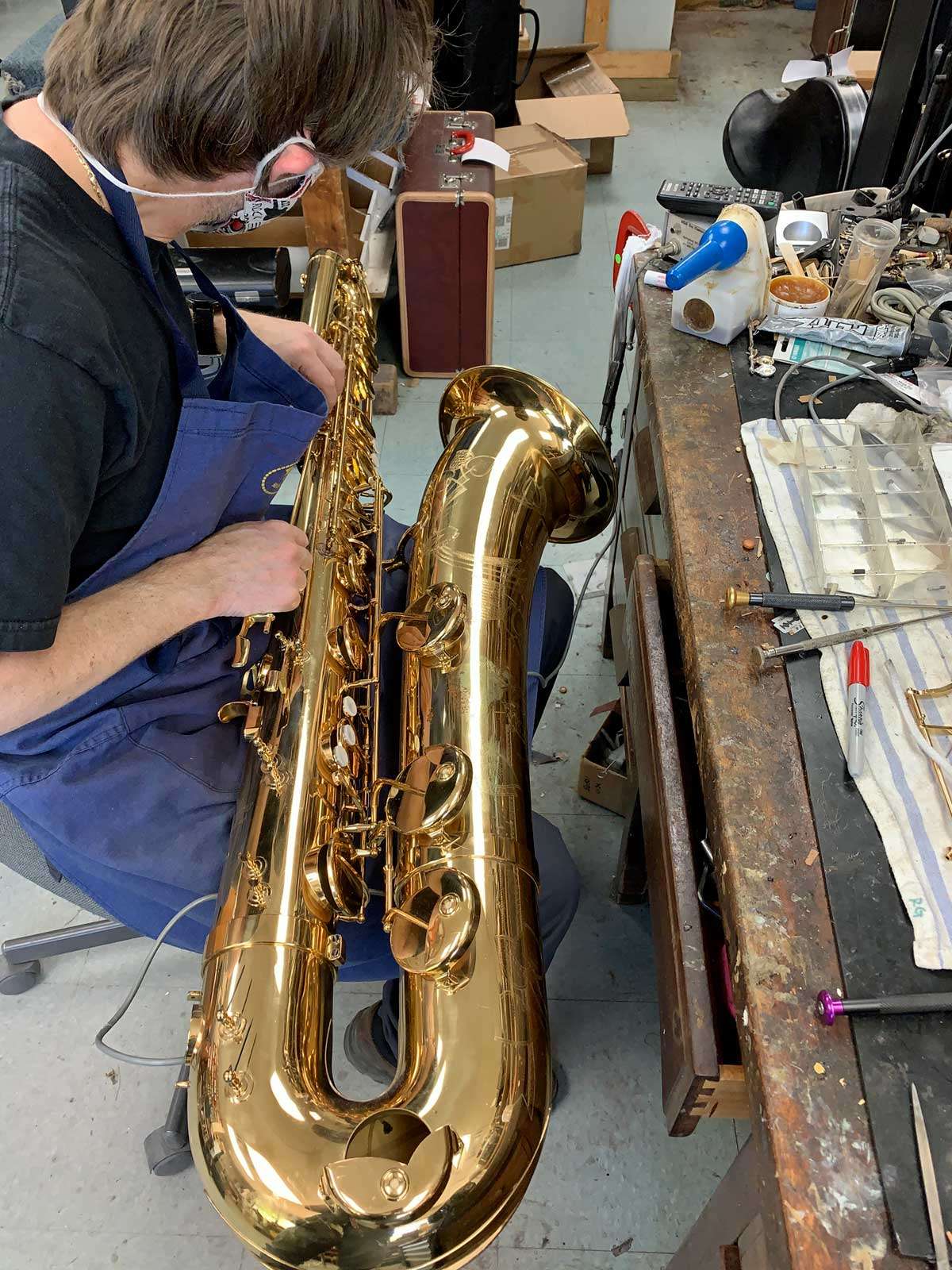
I am not a believer in doing my own repairs. I am NOT a repair tech. I did NOT go to school for 3 years; create a project instrument; do an apprenticeship; write an exam; and on, and on, and on…
Watching YouTube videos is not the same as learning from real instructors, and then by experience through a proper apprenticeship with properly trained supervisors. Period. Full stop. 
Without exception, every instrument that I have bought from a player who said that they “overhauled” it themselves, was a joke. Some were barely playable. In some the pads were held in with tape. That’s why I always tell people: If you buy a new-to-you horn from a private seller*, budget for an overhaul immediately. This way if you don’t need one, then you’re ahead. However, if you do need one, then you have the $$ already available from the start.
*NB: It is worth noting not all dealers are the same. Some dealers specialize in [vintage] saxophones and their restorations. They only sell fully functioning, overhauled instruments. If they sell one that isn’t overhauled, the will advertise it: SOLD AS IS.
On the other hand, there are dealers who don’t specialize, and sell things in a wide variety of conditions. That’s why you have to take your time; do your research into dealers; and shop around.

Regarding your statement, “Without exception, every instrument that I have bought from a player who said that they “overhauled” it themselves, was a joke. Some were barely playable. In some the pads were held in with tape.”
We have a plumber in town who has a slogan on his tool truck, “We fix your husband’s plumbing repairs!”
I would understand your skepticism. D.I.Y. instrument repairs are not for everyone. Some have a knack for it. I know some high school band teachers who have become excellent techs. Those who don’t by all means should take it to a competent tech for repairs.
My late 1980’s Le Blanc 7133T Vito tenor (I say late 1980’s because it came in a brown Le Blanc rectangular sax case with red interior, 1990’s came in a black case – S/N records are sparse on these KHS Jupiter stencils). Interestingly I bought from a Canadian offering it for sale on US eBay in 2010. I paid a touch over $400 for it including shipping. Around 2016, its pads were totally shot.
I bought new pads with resonators and other necessities. Cleaned and overhauled it myself. Didn’t have a leak light, did the best I could but still had leaks. I sidelined it, bought a new tenor. Last year decided I would stop fooling with it and took it to the local music store.
Music store tech in Lubbock, TX called me about a week later, told me that someone overhauled this sax but it has leaks! I didn’t admit to him who did it, just told him if he saw it needed any other repairs, to call me and I would authorize them.
Sax came back a week later, their charge for servicing was $151.12. I paid about $80 for pads and a few other items, essentially I got a complete overhaul for $231. This is the sax I use in the community band.
I have met one or two techs that were never actually trained who were incredibly good and successful at their craft. As their careers progressed along, they took either some formal or informal training along the way.
Just like any so other professions, musical instrument repair technicians are part mechanics, and part artists, who have their own professional professional association.
What makes the really good ones stand out IMO, is:
1. A natural aptitude for mechanical things.
2. An interest in continuing professional education.
3. An ability to think outside the box, and creatively problem solve.
4. Access to the right materials and equipment, and the knowledge of how and when to use them.
Yes I have to agree with you there, your observations are spot on.
I read Stephen Howard’s website blog on his experiences and observations with various makes and models, which follow along these lines. With him all the boxes are checked. His goodness is that he is brutally honest so you get a good heads up.
Regarding your points #3 and #4, I enjoy reading tech’s experiences where they had to create their own special methodologies and tools to solve a specific problem.
Also I learned in certain cases that techs resort to use of silver solder because it provide a much stronger bond than lead/tin soldering. However, it does require practice and skill as the temperature to melt silver solder is higher than with lead solder.
I have only done silver soldering once with the lowest temperature rods I can find to fix copper plumbing piping. It worked, but with experience could have done better. Plus this was on a consumer hobbiest quality mapp gas setup, which is less than a standard acetylene torch.