


Saxophone & Gear Reviews


Originally published March 2016. Updated March 2026.
Oh what a difference 10 years make. Although I haven’t played another one of these Jinyin-made, vintage American style—AKA long wrap—bass saxophones since I played this one in Vancouver exactly 10 years ago, A LOT has changed in the bass sax landscape. As a result, this review was in desperate need of some updating.
There is a brand new conclusion at the end that updates what I recently discovered about the current crop of Chinese-made, long wrap bass saxophones, and where I be directing my research inquiries next. 
Jinyin-made bass sax
Stencil name: XuQiu. However, Jinyin stencilled bass saxophones for anyone who ordered them including, but certainly not limited to: International Woodwind, Orpheo, Hawk, and Gear4Music.
Price: Varied widely. Ranged from $2,000 to $8,000 US – depending on stencil label
Date of manufacturing: circa 2010
Date of review: 2016
In Feb. 2016, I met a local player who owned a Jinyin-made bass sax stencilled with the name XuQiu. Since my website is one of the few (the only?) on the Net that has an extensive pictorial and brand-name inventory of both Jinyin and Jinbao-made bass saxophones, I thought I should at least make an effort to play the instrument—since I have not seen, let alone played one of these cheap Chinese bass saxes before.
I must admit, I was fully expecting that this instrument would be the saxophone equivalent of a tin can. However, this Jinyin-made bass sax was anything but. It was heavy as hell. It was likely as heavy as, if not slightly heavier than, the Buescher True Tone I owned at the time. Quite frankly, that surprised me, and the surprises didn’t stop there.
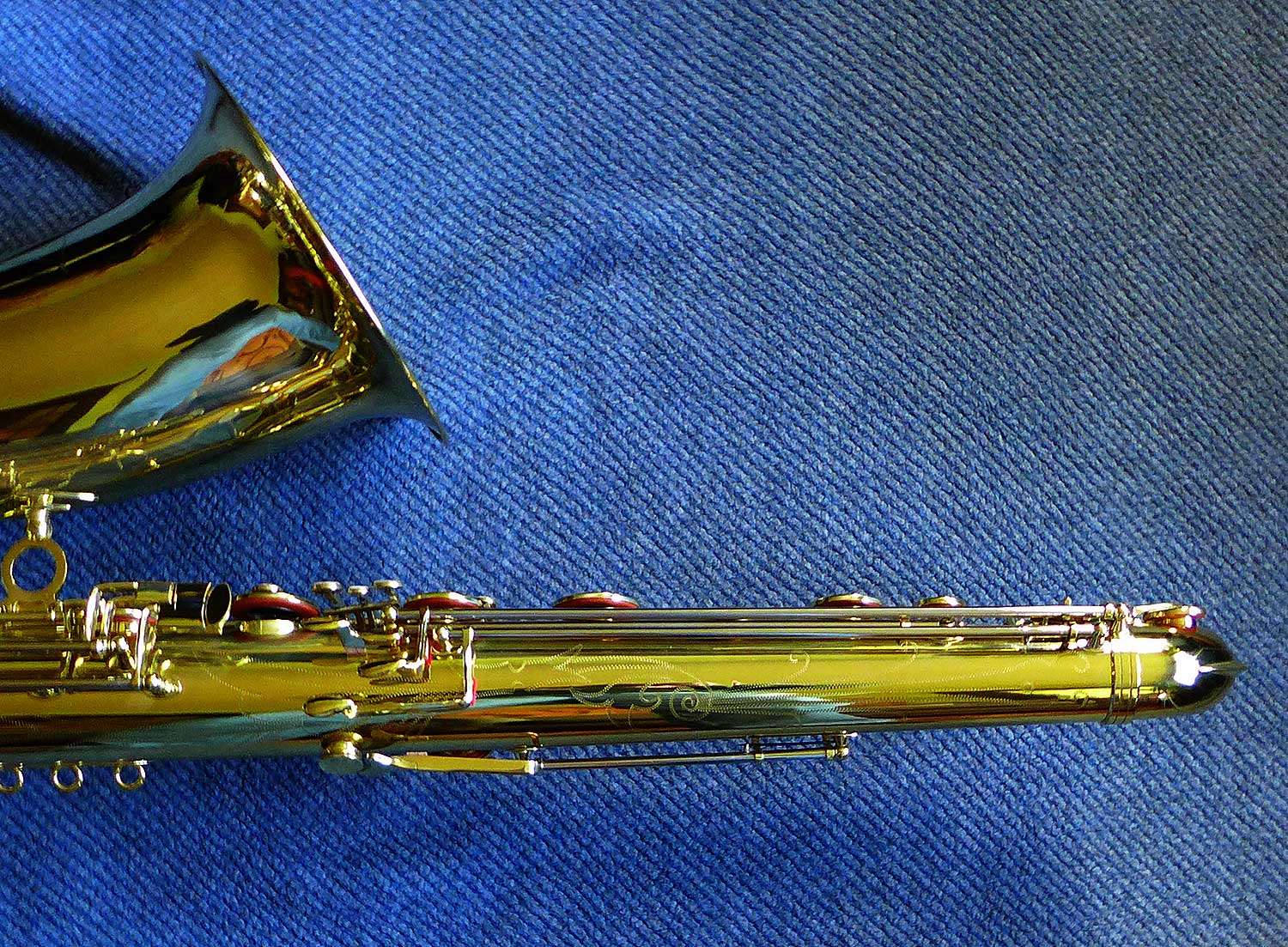
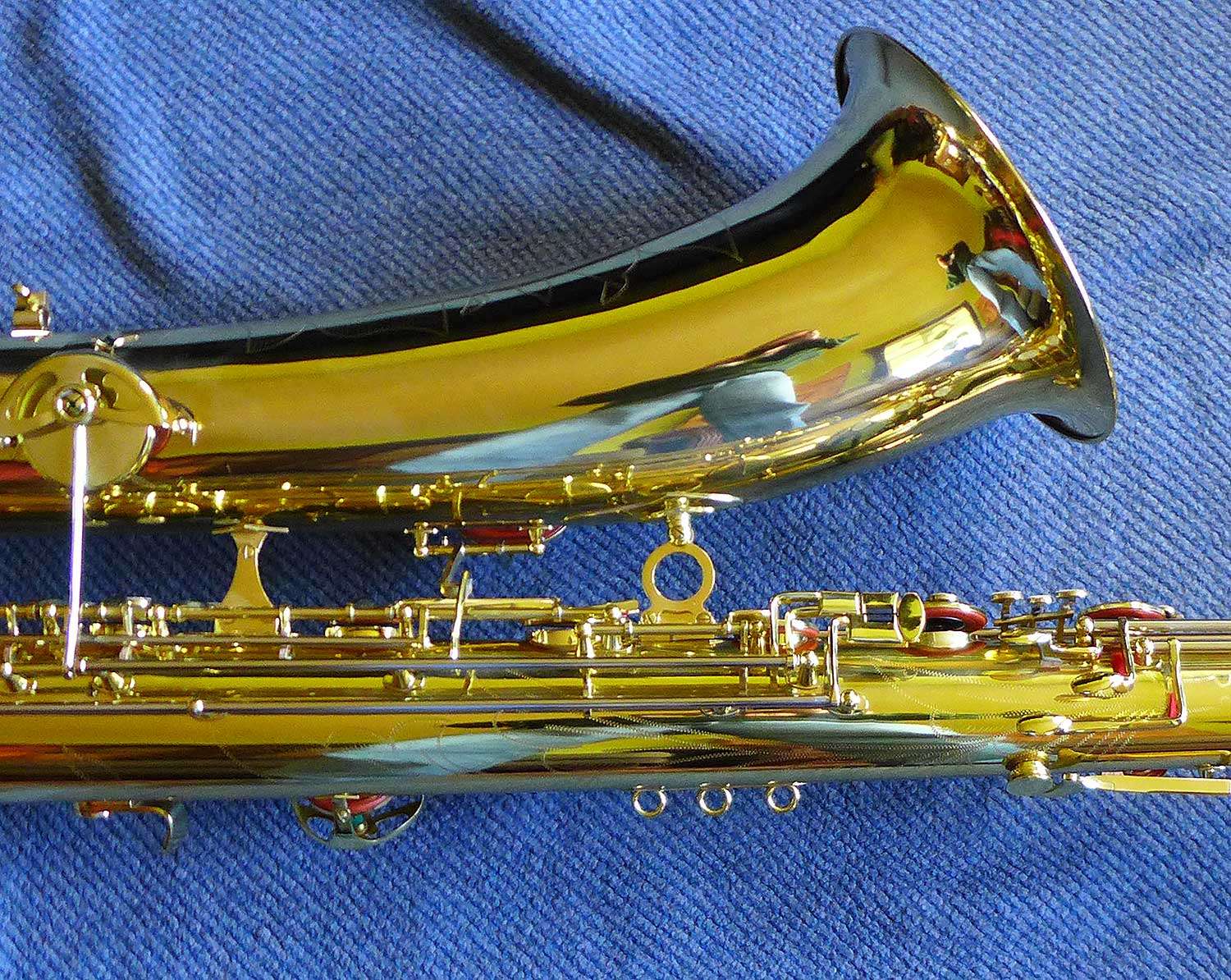
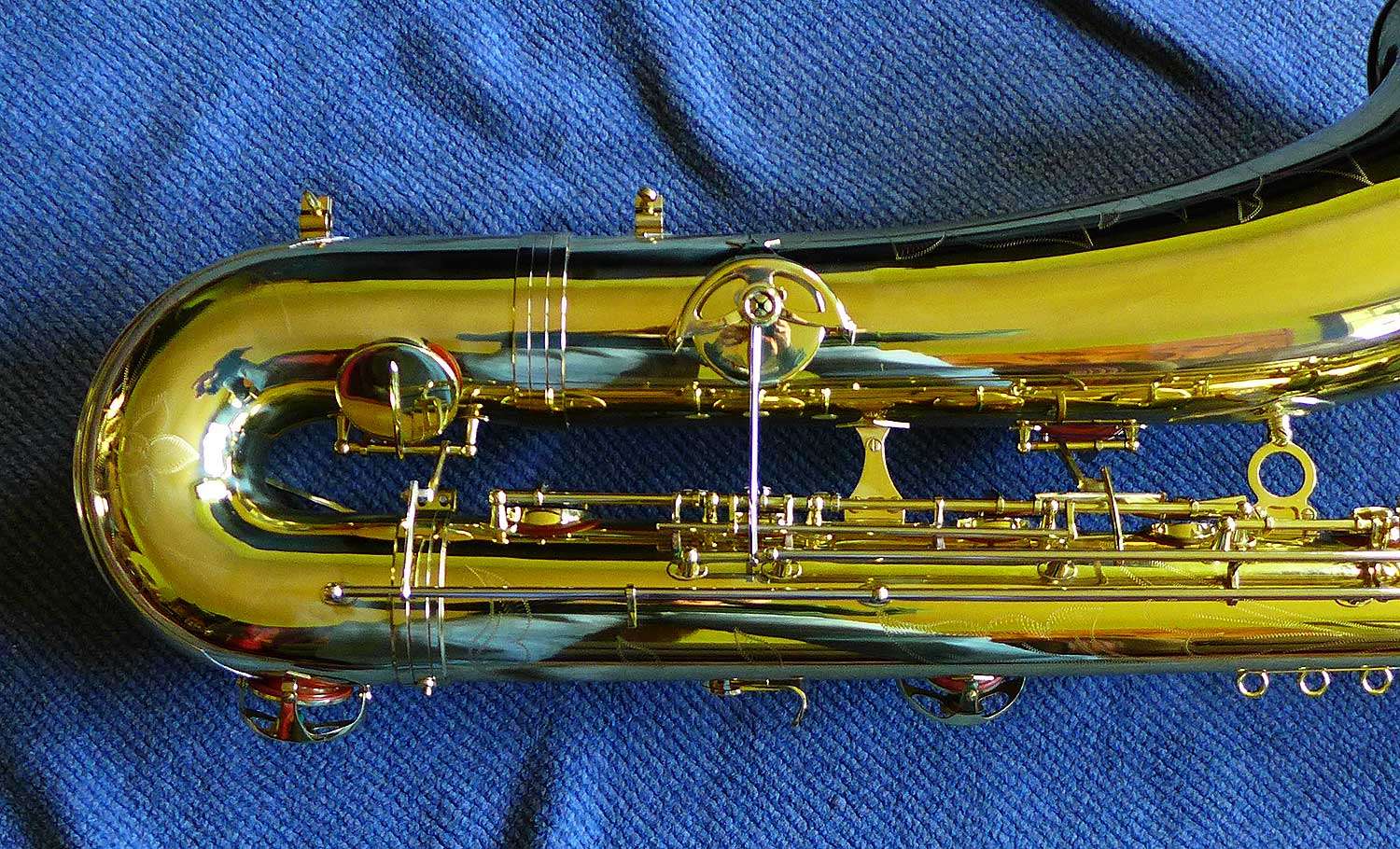
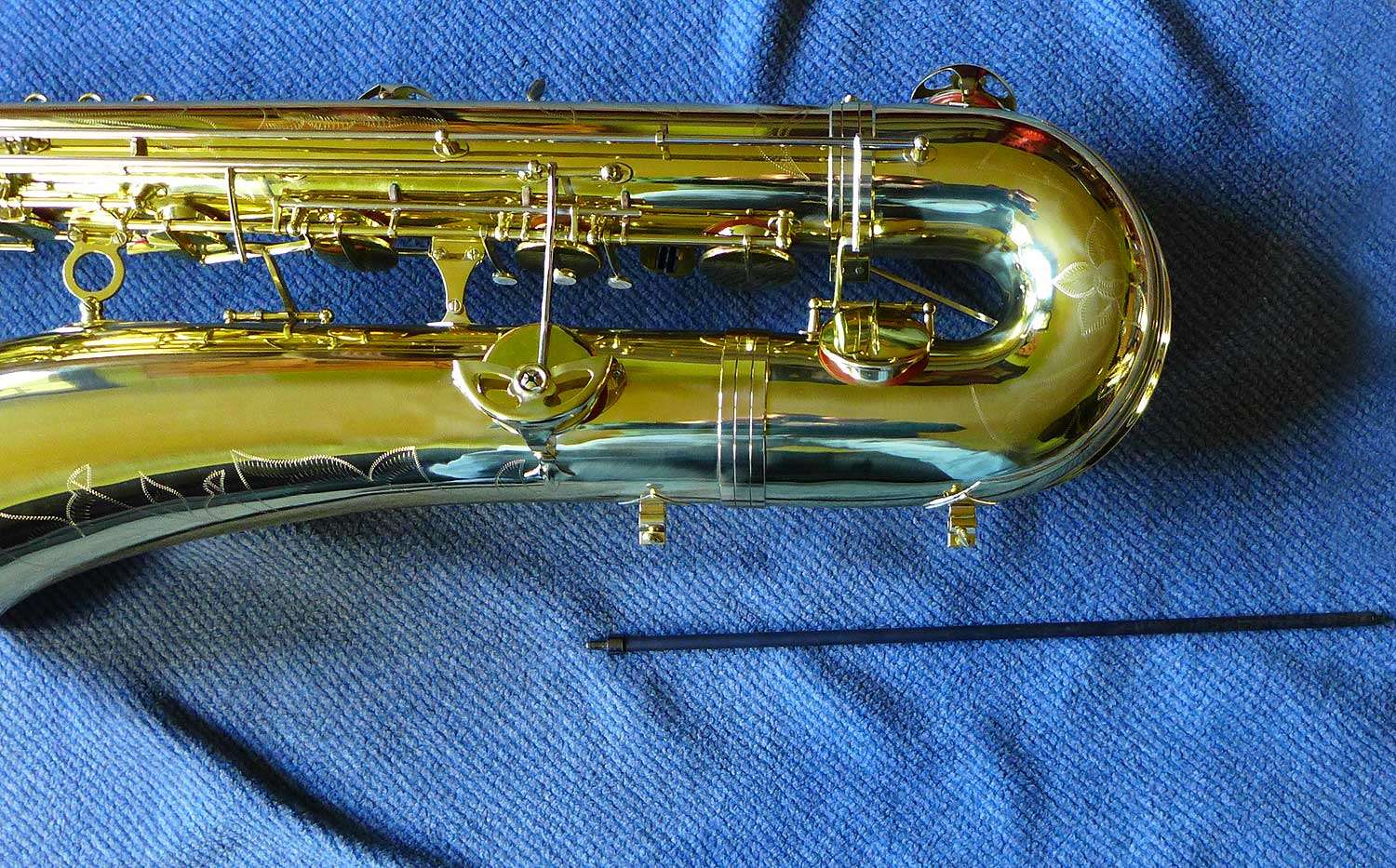
Note: I apologize in advance for the quality of the photos in this review. Since I was shooting these in the owner’s living room, there are a lot of reflections of objects—mostly me  —in the lacquer of the horn. I also didn’t have my tripod with me, and my neuro problem had been giving me quite a bit of grief at that time. Some of the pics are not as clear as I would like them to be. Oh well
  happens.
Specs
- Tuned in the key of Bb – one octave below a Bb tenor.
- Keyed from low Bb to high F.
- Lacquer finish with laser (hand?) engraving.
- Leather pads with a mix of metal and nylon resos.
- Weight +/- 18lbs.
- Adjustable right thumb rest.
- Triple strap ring.
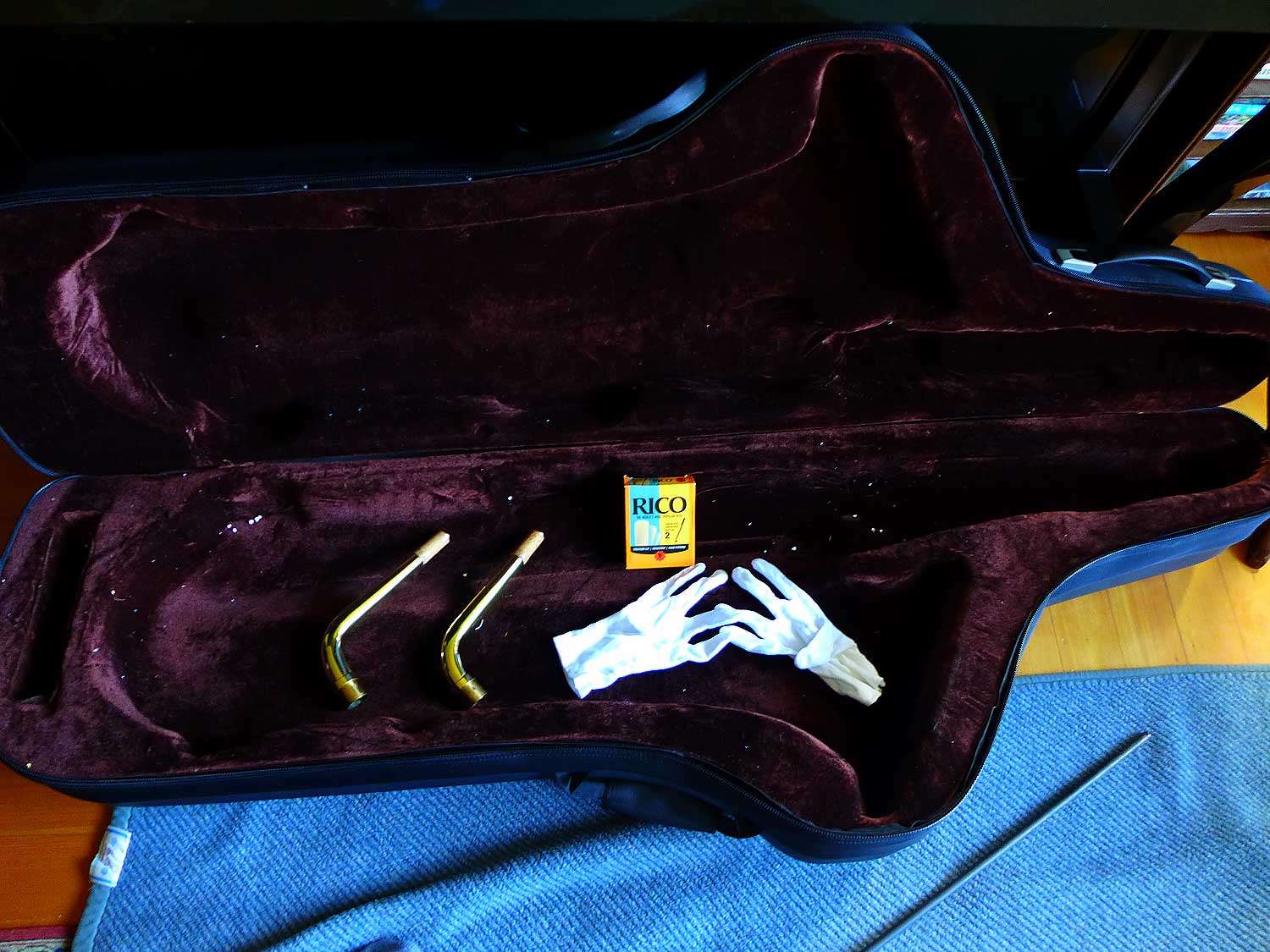
- Carbon fibre peg to avoid having to wear this piglet around your neck.
- Lightweight case with wheels for ease of transport.
- No name bari mouthpiece that has NOT been modified for bass saxophone.
- White gloves (because nothing from China comes without white gloves, apparently).
Set-up used for the playtest
MP
Runyon #5 blank
This is my primary bass saxophone MP. (Shown here together with vintage Geo Bundy bass sax pickle barrel mouthpiece.) It was customized specifically for bass saxophones the same way Santy Runyon did for the great bass players back in the day.
How is it customized? As described in detail by Paul Coats himself on my website, the usual baritone MP facing of 24mm – 25mm has to be lengthened to about 29mm – 30mm. This allows for more of the reed to vibrate freely, and the bottom end of the horn to speak properly.
Reed
- 2½ Fibracell reed (One of the good, older ones circa 2005—before the company started producing junk.)
Tone
The tone of this Jinyin-made bass sax was what you would expect from an American-style bass sax: big, fat, meaty, sonorous, and in my case, reedy.
If a listener were blindfolded and a player were to play a vintage American bass, and this Jinyin-made bass sax back to back, I believe it would be hard to tell which instrument was which. Perhaps the only thing that would give it away would be its intonation. More about that directly below.
Necks & Intonation

Like many Jinyin-made basses, this XuQiu came with two necks. I did not have with me a means to measure them, but the owner told me the difference was ½” in length. I’m not sure how accurate this measurement is, but I can tell you that while the different necks didn’t differ in tone, they did differ greatly in intonation.
Using my regular chromatic tuner, I found that the short neck provided accurate tuning from C#2 through the palm keys. However, from C2 and downwards, the instrument was horribly out of tune.
I then tried the longer neck, and found that from C2 downwards was decently in tune, with only a few issues. These might be correctable through key height adjustments, or perhaps tuning crescents in some tone holes. However, since I only played the sax for <15 minutes, more time on the horn would be necessary before a truly accurate diagnosis of the poor tuning can be made.
The longer neck did not adversely affect the tuning of C#2 and above, which would mean that for my mouthpiece and reed set-up, the longer neck would be the correct one for this horn.
All in all, I would sum up the intonation on this sax as fairly easy to control. As a matter of fact, I found it easier to control than the intonation on my Buescher bass. It was less fussy, and more like a conventional saxophone. Go figure. 
Response
When Jinyin copied the vintage American bass saxophones, they managed to copy not only their great tone, but also their unevenness of scale. D2 is pretty much unplayable at first, and needs to be coaxed out. Vintage bass players generally use the palm key D to vent the D2 rather than the octave key. I didn’t have a lot of success with that trick on this Jinyin-made bass sax. For me, I found the best trick was to overblow D1 (sans octave key) and hit D2 that way.
C2 was also as problematic on this XuQiu bass, as it is on most vintage American bass saxophones. Side C seems the way to play it best.
Other than those two really problematic areas, this Jinyin-made bass sax responded quite well. It played up and down its entire scale quite well. Given that it hasn’t seen the inside of a shop in a couple of years at least, and doesn’t get played, but rather sits on the floor in the living room in its case—where it might be subject to the occasional bump to its case—this beastie shows a great deal of potential. It certainly has no worse a response than my Buescher when it hasn’t been to the shop for a while.
Feel
This is where the Jinyin-made bass sax wins hands down over its American-made predecessors. Ergonomically there is no comparison. It is the saxophone equivalent of comparing a Ford Model T, to a car of today.
The XuQiu bass saxophone’s keys are quite well laid out. Not only that, it has all those things that are missing in most vintage American horns: a bis Bb; a range to high F; an adjustable right thumb rest; as well as triple strap rings, which allow you to adjust how you position the horn when playing it (in your lap, hanging on your side).
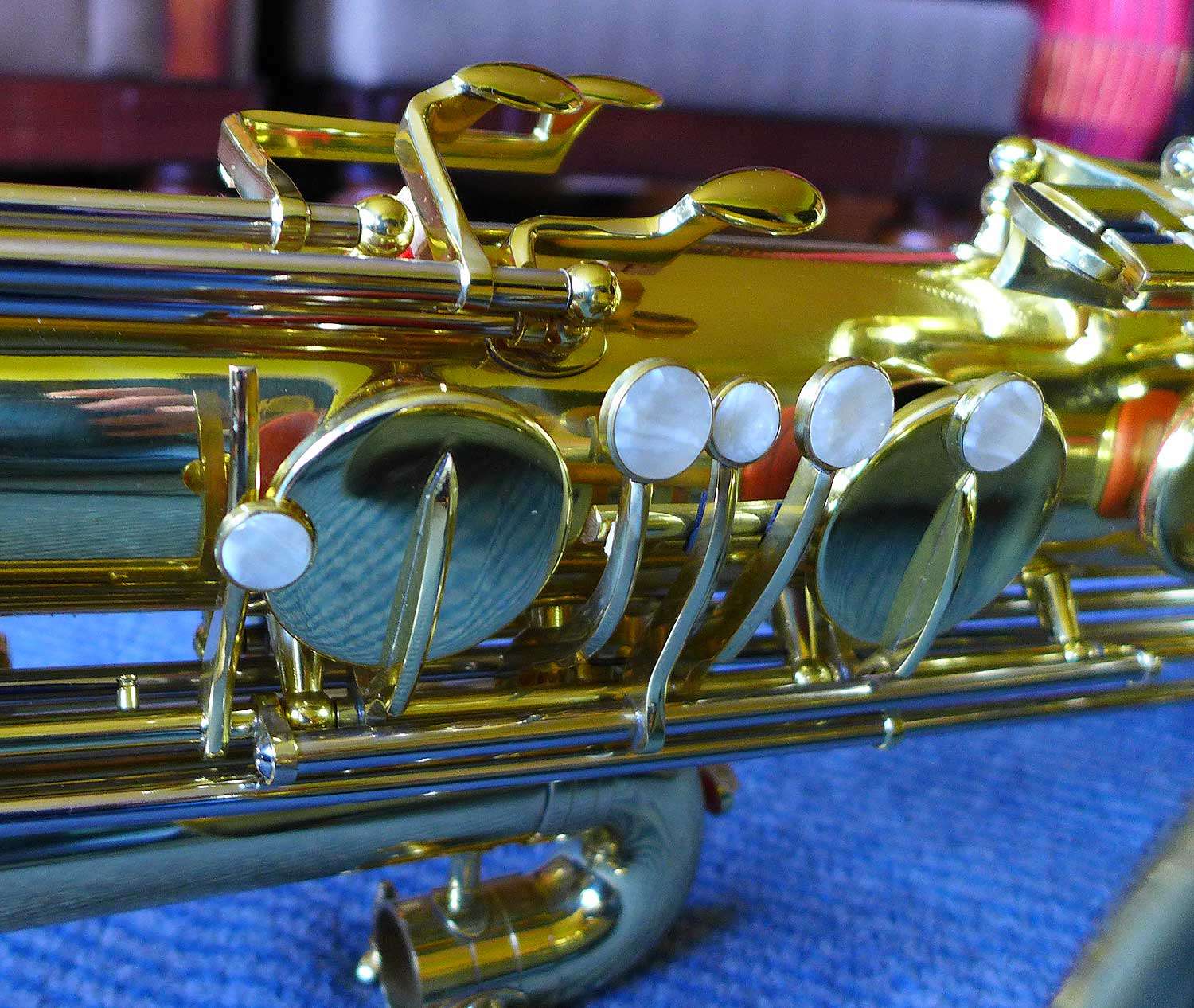
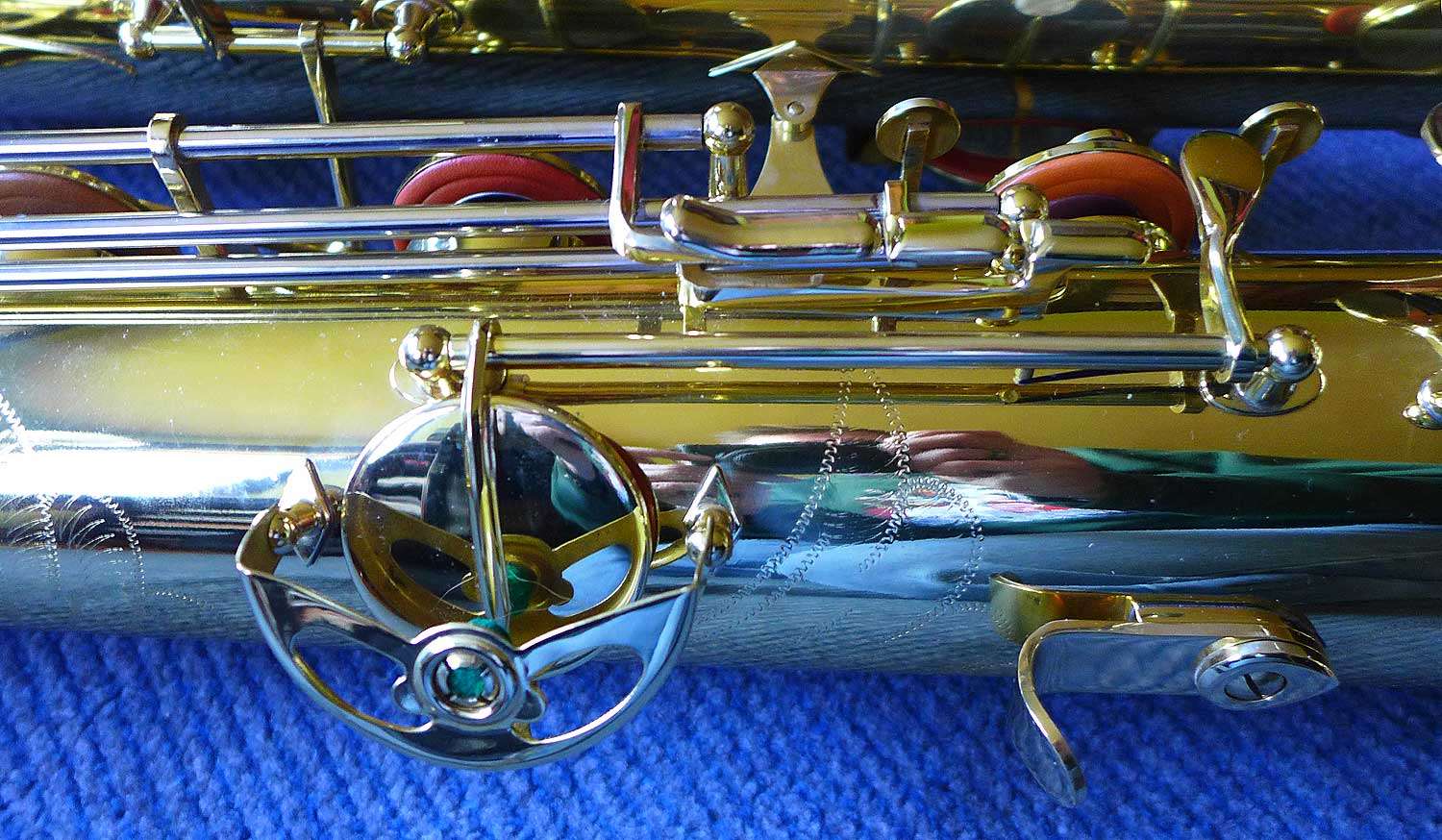
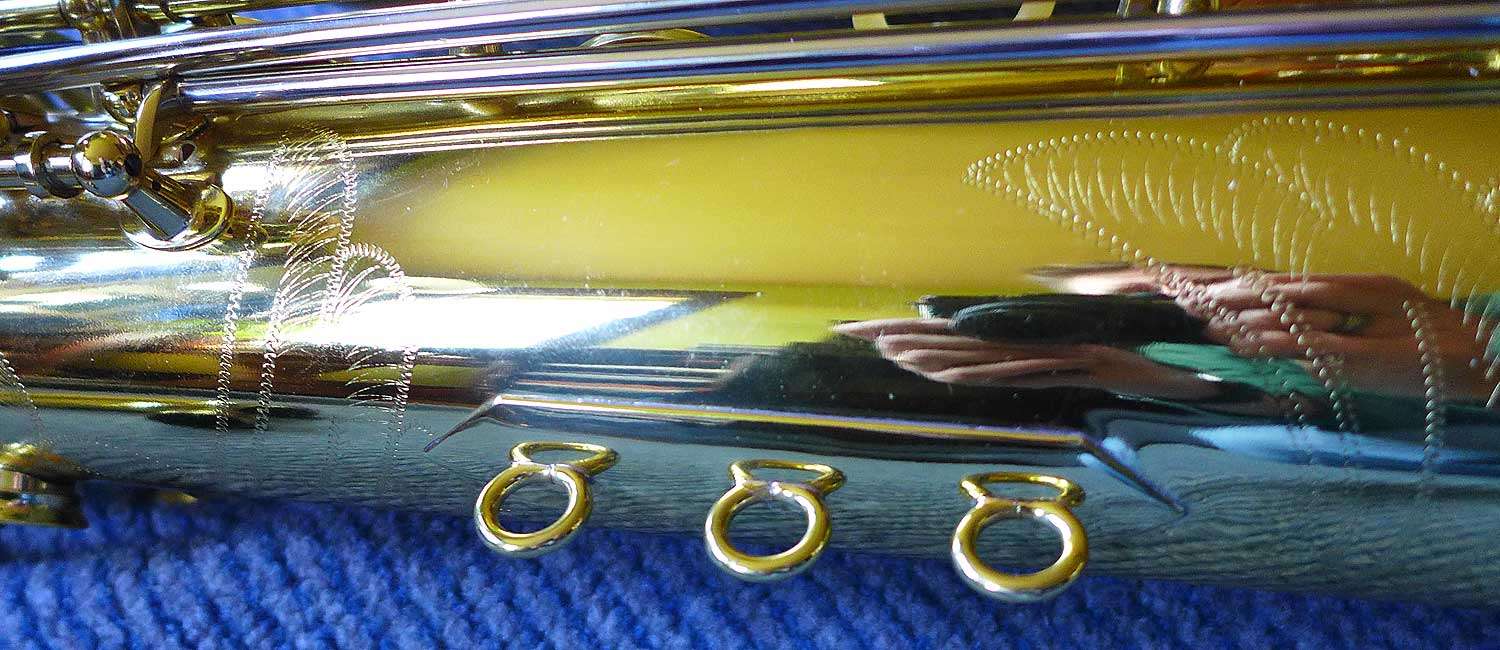
My favourite riff for testing a horn is the intro to In The Mood, starting on Bb 2. Starting on that note ends the riff on low Bb. This XuQiu bass played this riff amazingly well.
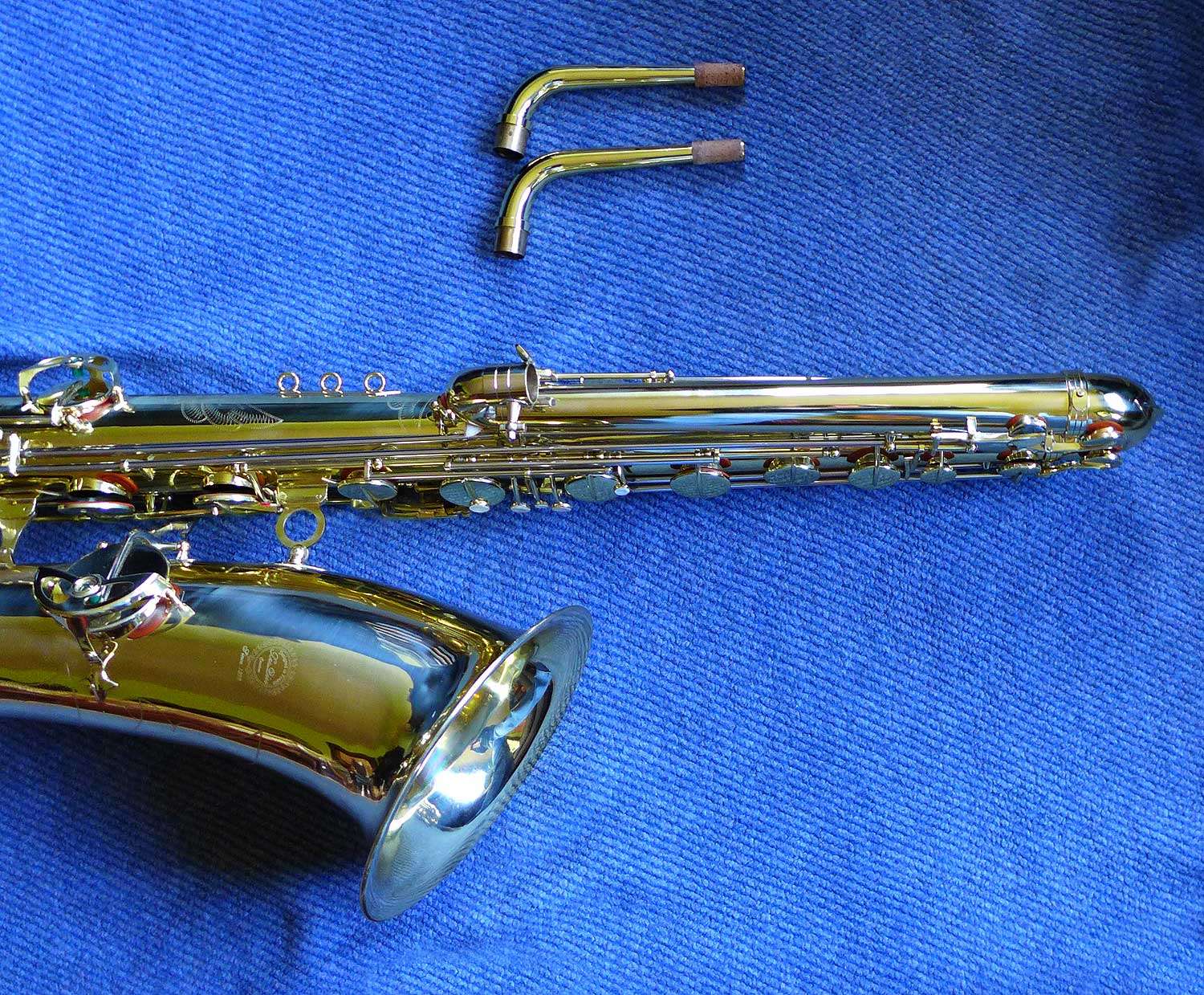
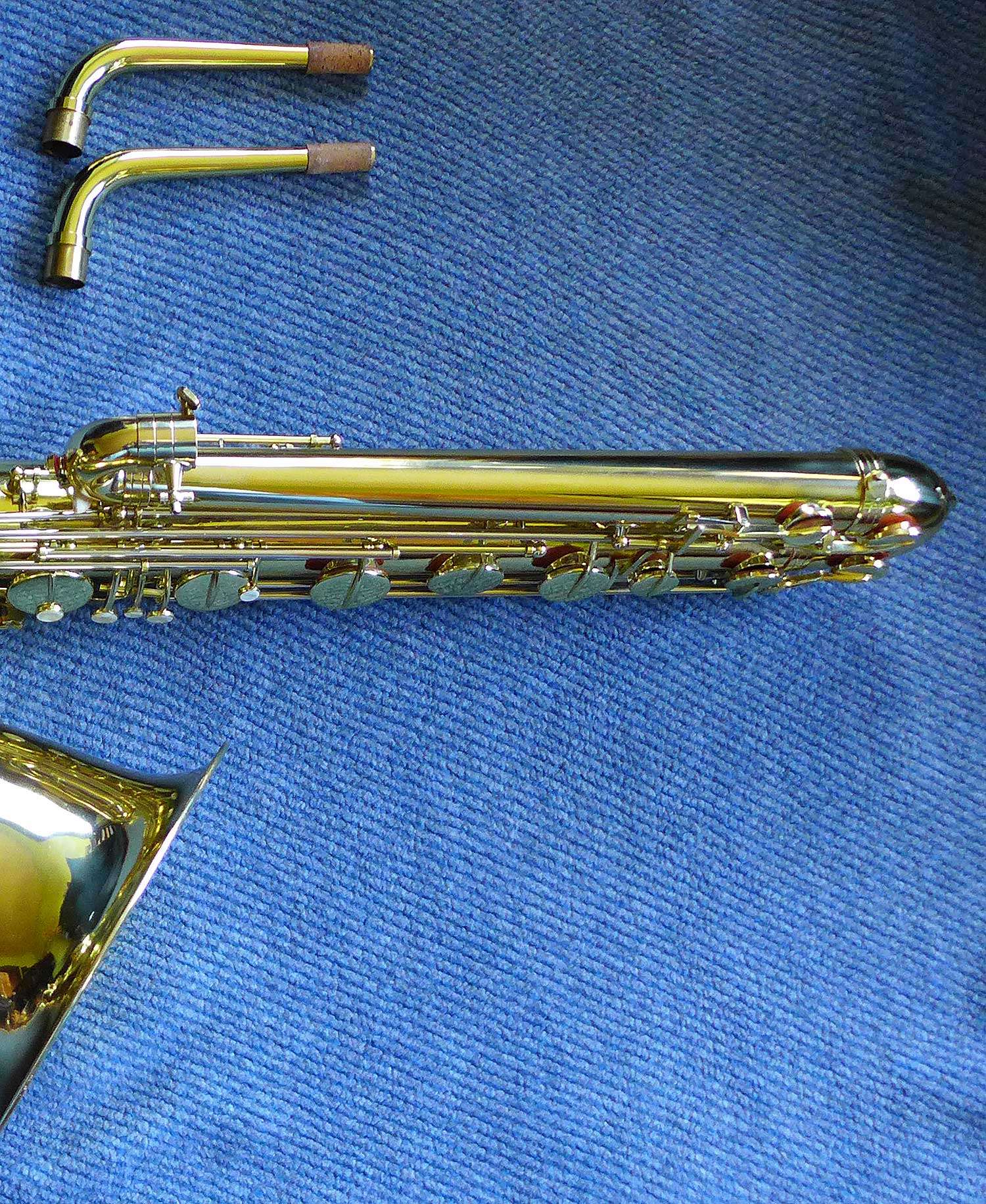
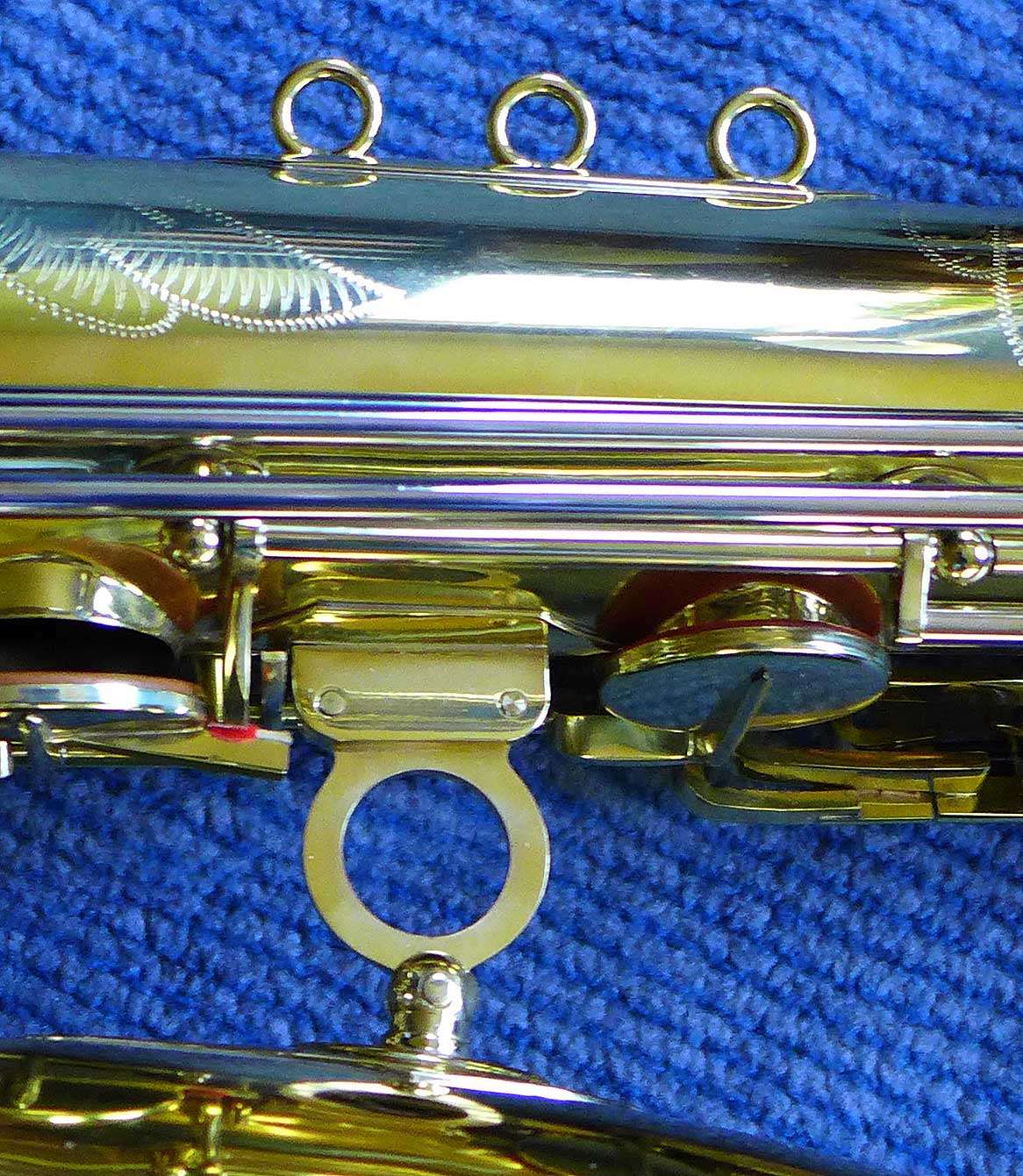
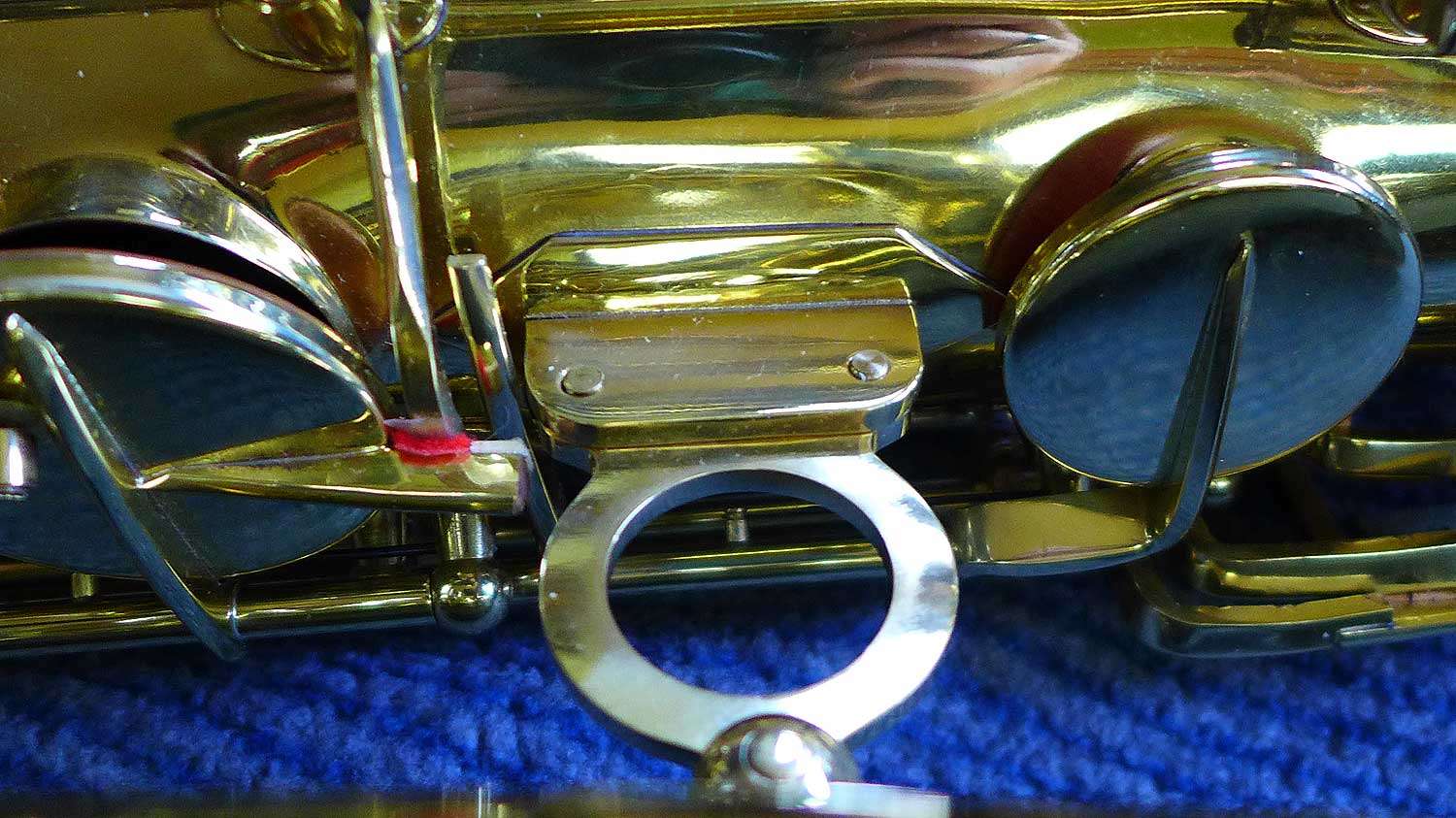
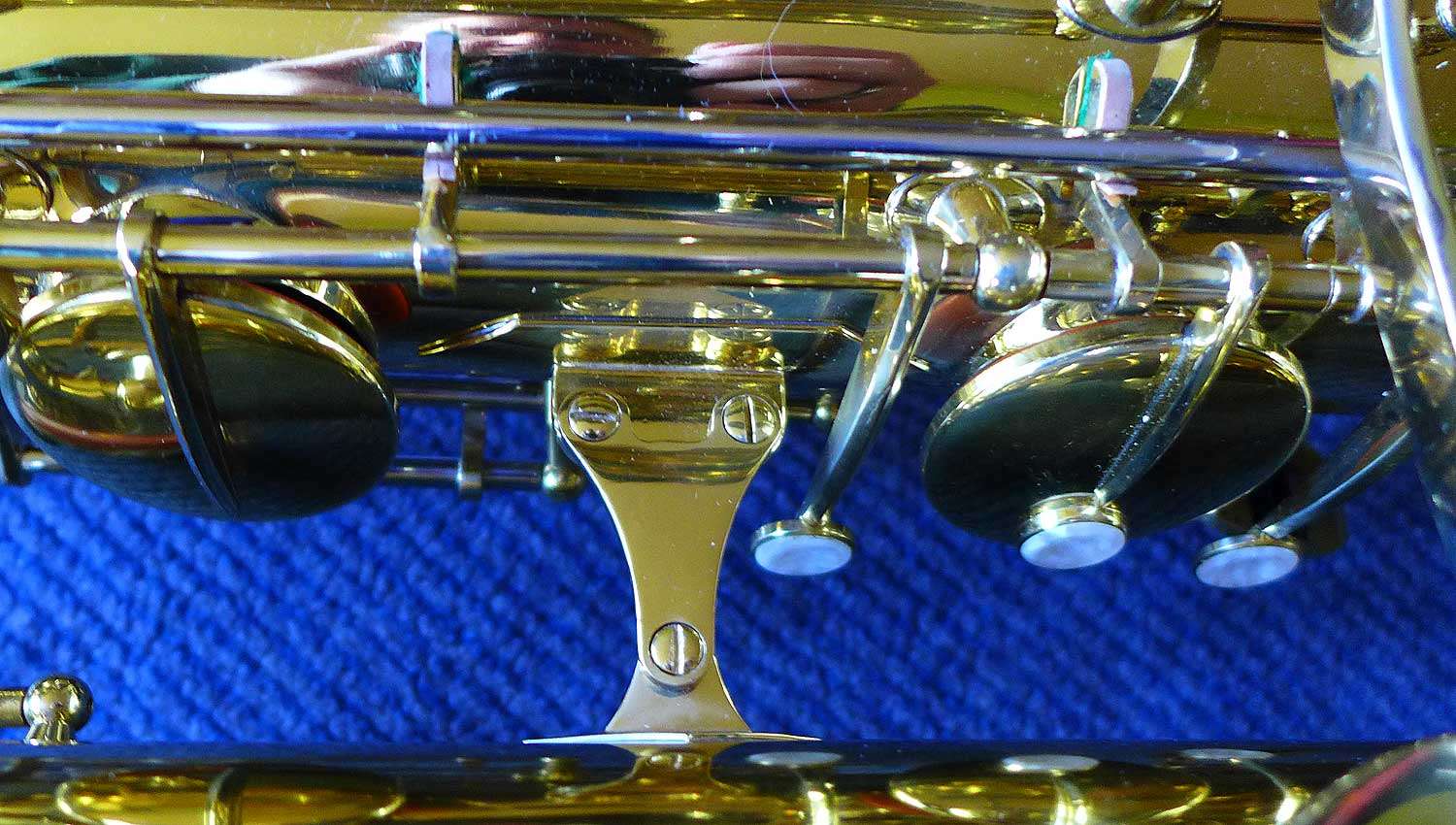
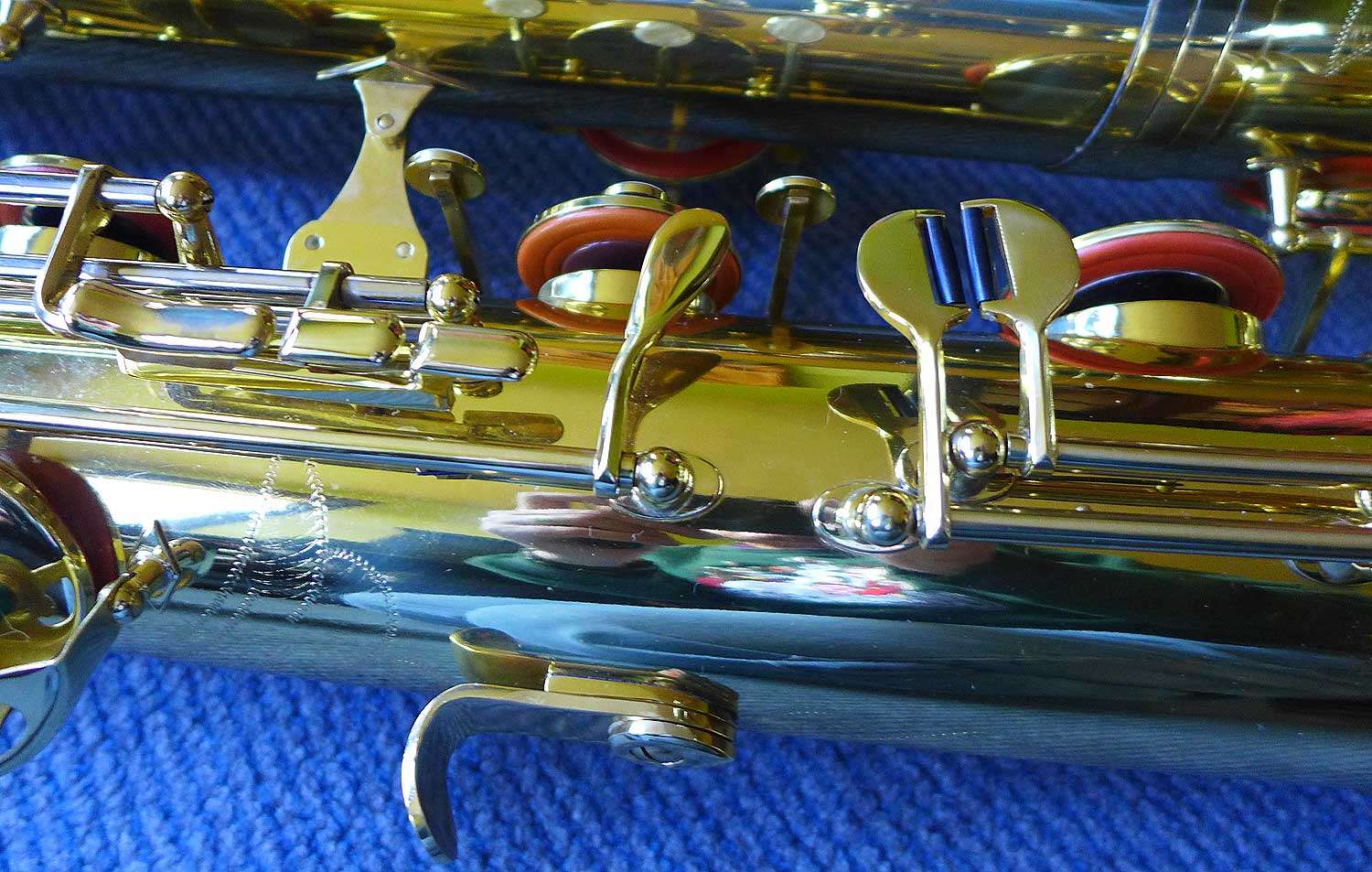
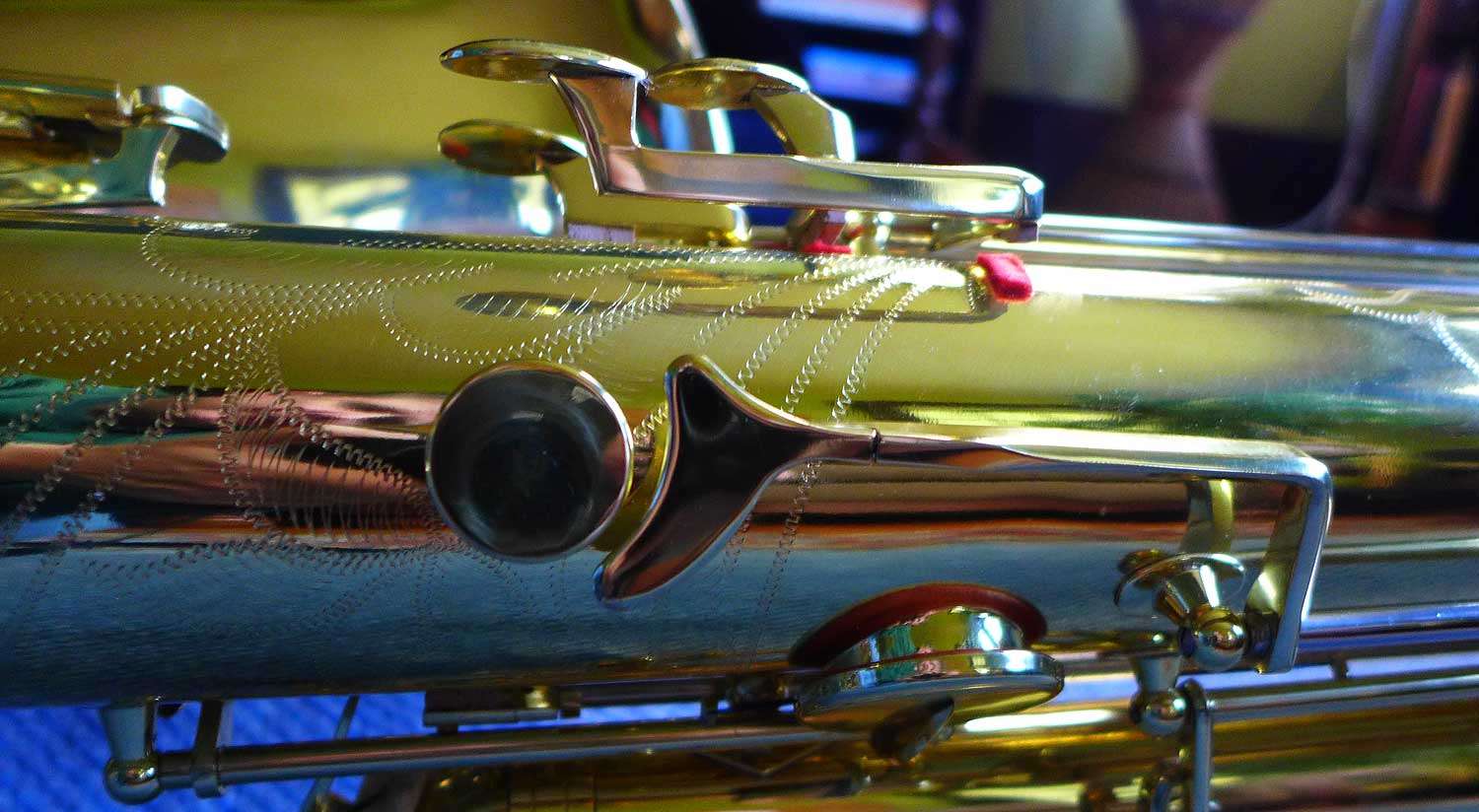
The left palm keys are not the best that I’ve ever encountered, but they are adequate. What is not so adequate however, are the rollers on the left and right pinkie keys. They are so tiny, it’s like they’re from another instrument. As a matter of fact, in the photos below you can see the extra space around the rollers. Clearly Jinyin didn’t get larger bits of plastic to use for their bass saxophone rollers. And yes, they are made of plastic, because the company didn’t spring for extras on this baby—like real mother of pearl or even hard rubber.
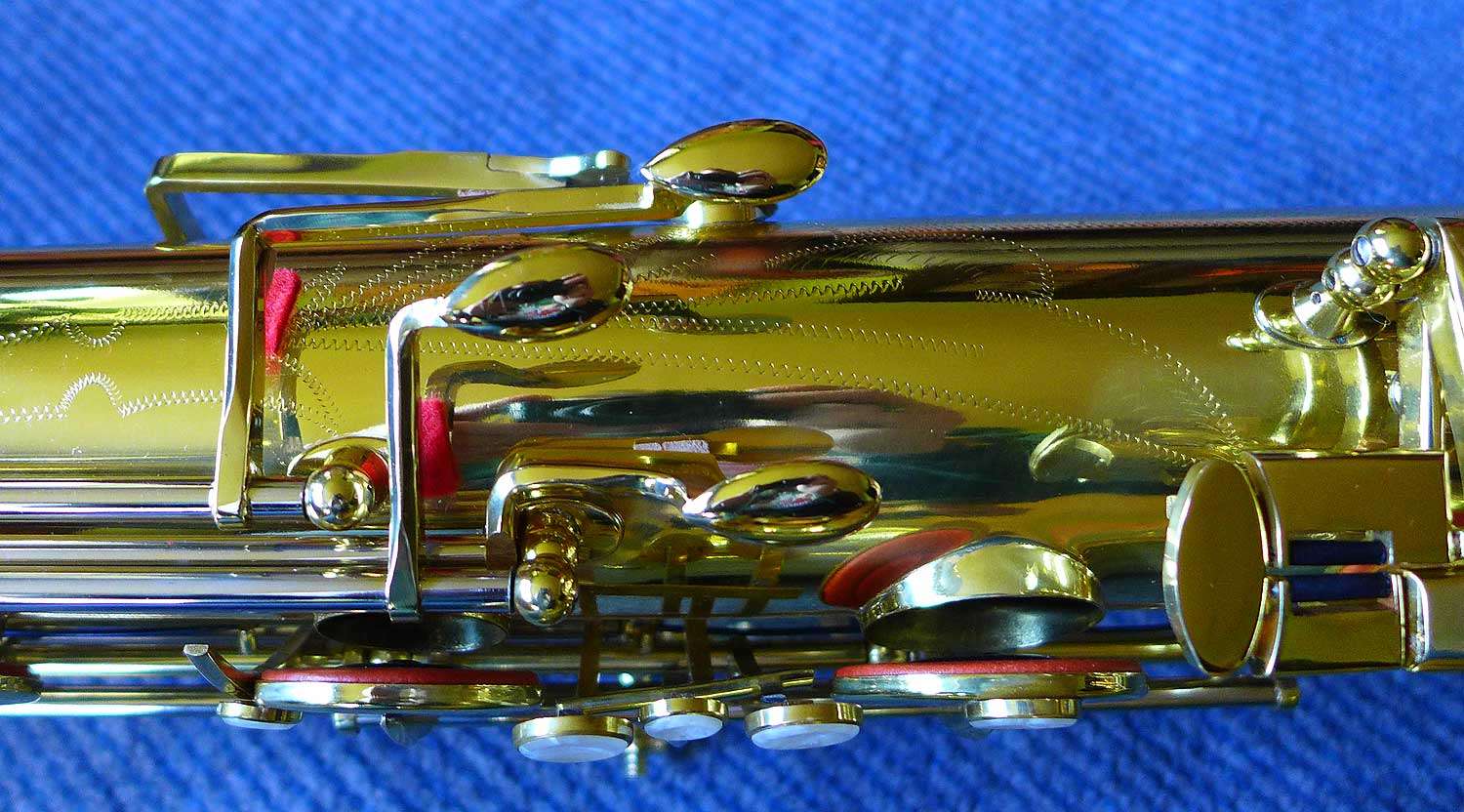
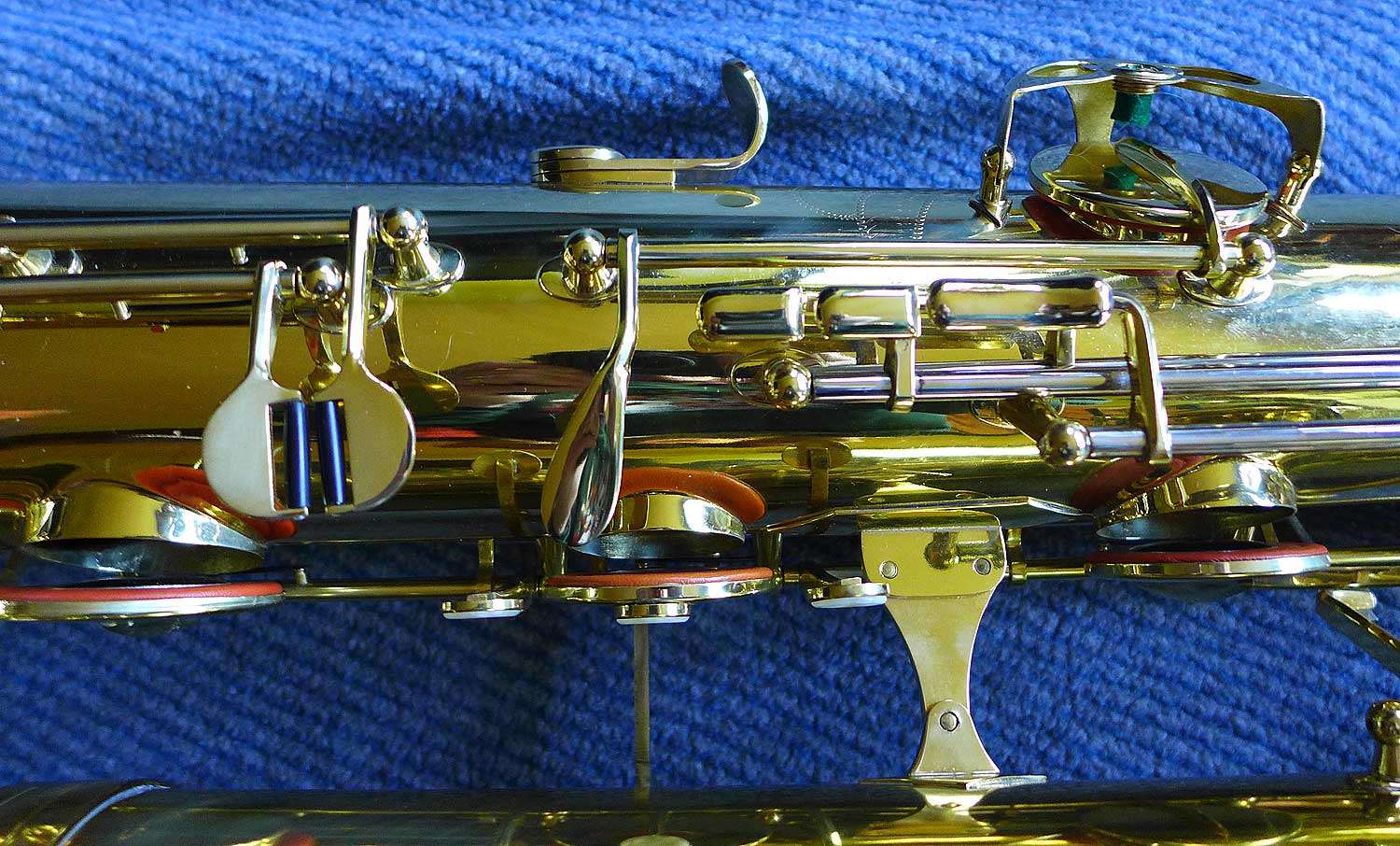
All in all, given that I was playing a bass saxophone that I was unfamiliar with, I found this a very easy sax to play. If I were to spend any time on it, it would be a snap to play—much easier than my Buescher. (And yes, it hurts to write this.) 
Build
Note: I am not a tech, nor do I play one on TV. I am however, a sax player with nearly 3 decades of playing experience who has spent a great many hours with my techs, talking with them, learning from them, and applying that knowledge to the saxophones that I purchase either for myself, and my students.
When I first lifted this Jinyin-made bass sax out of its case, I was amazed at how heavy it was. The owner told me that it was heavy, but I didn’t really think that it would be as heavy as my Buescher. I was wrong.
Detachable bows & body bracing
What the designers of this Jinyin-made bass sax did very differently to both Conn and Buescher is make both the upper and lower bows easily detachable. As with other modern horns, techs no longer have to unsolder these parts of the horn in order to do major repairs.
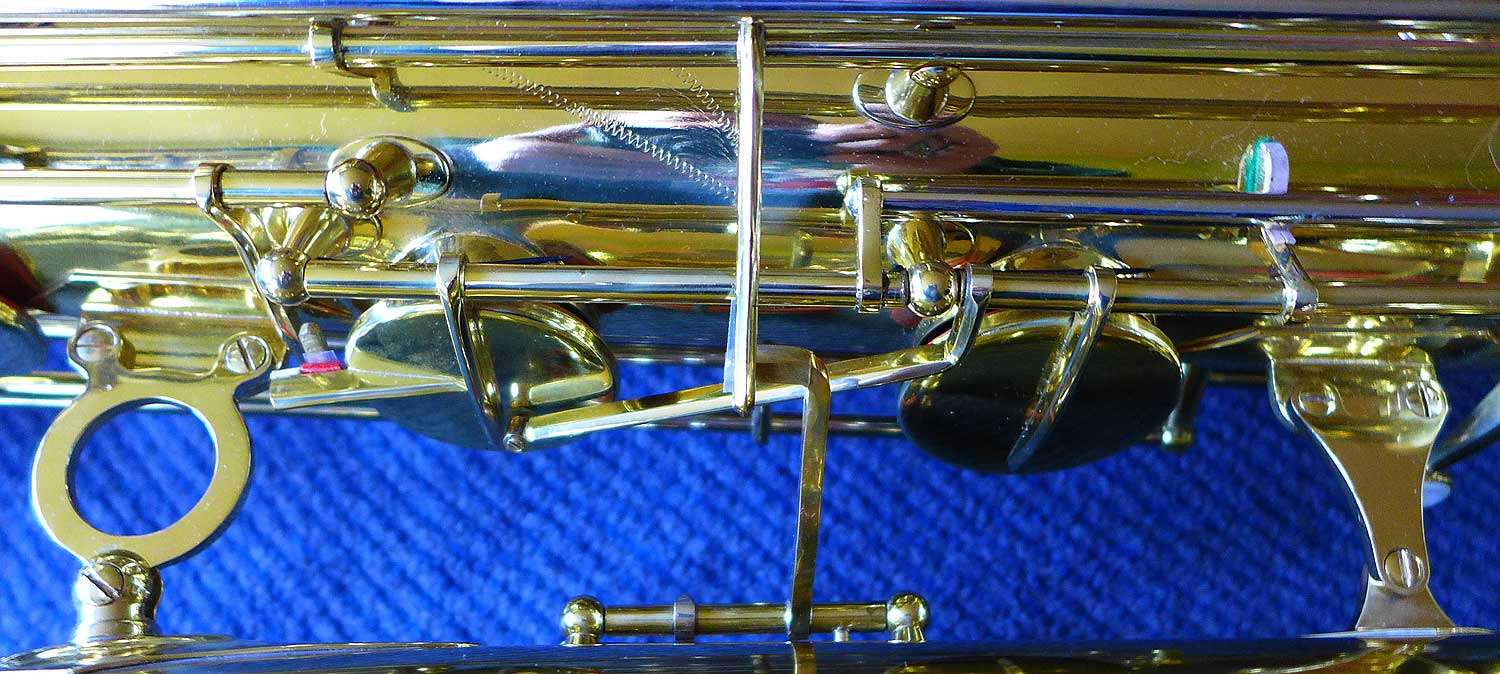
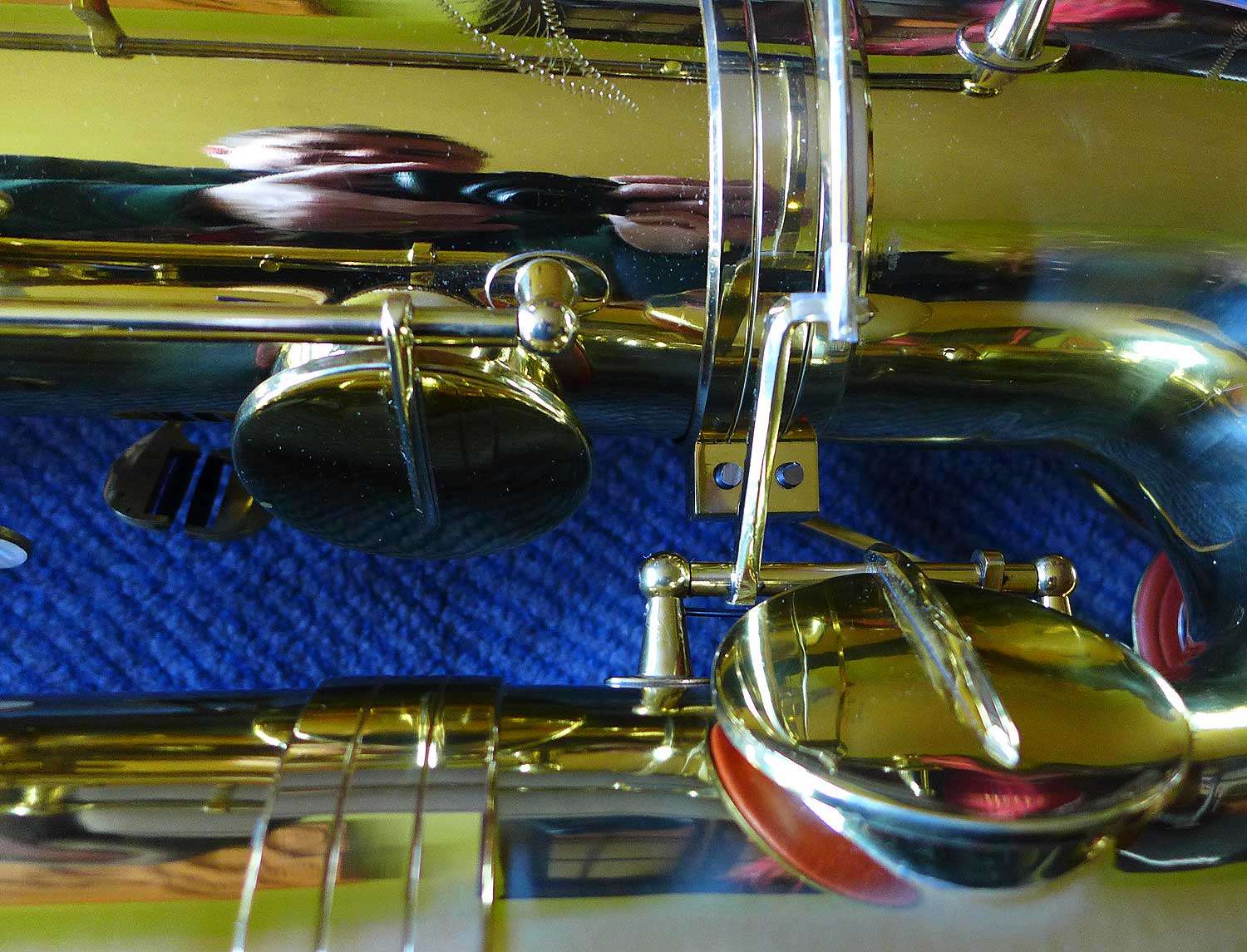
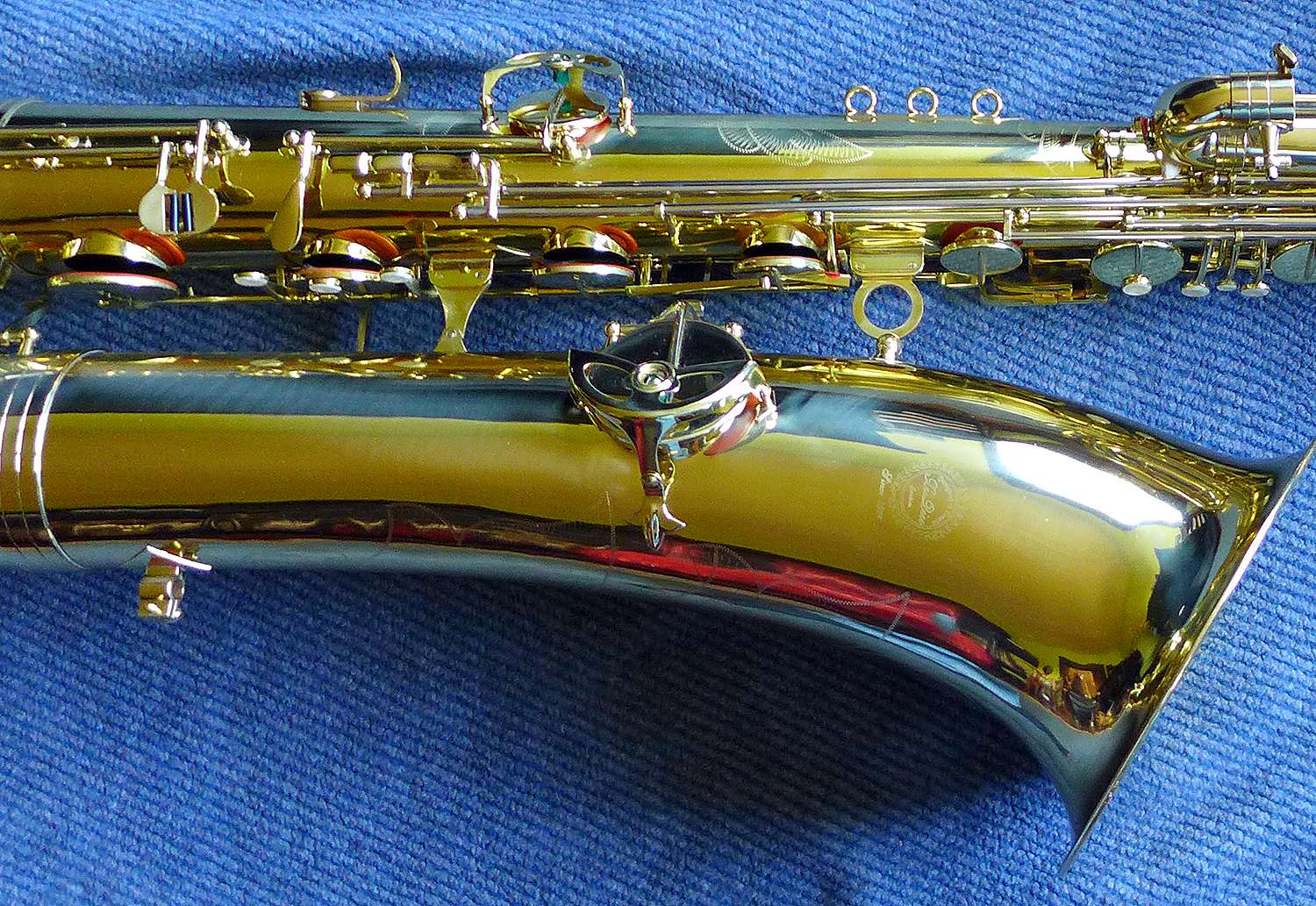
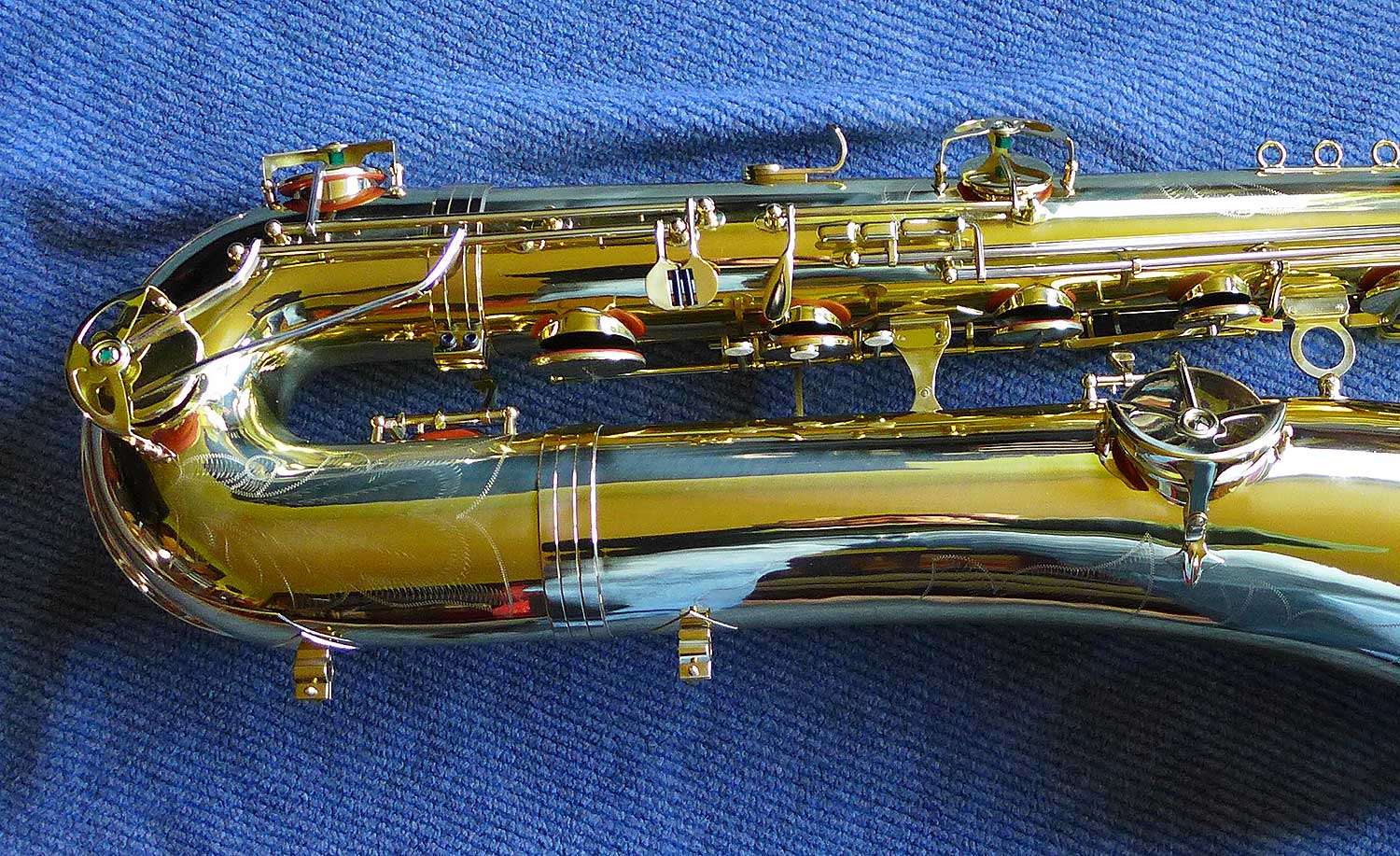
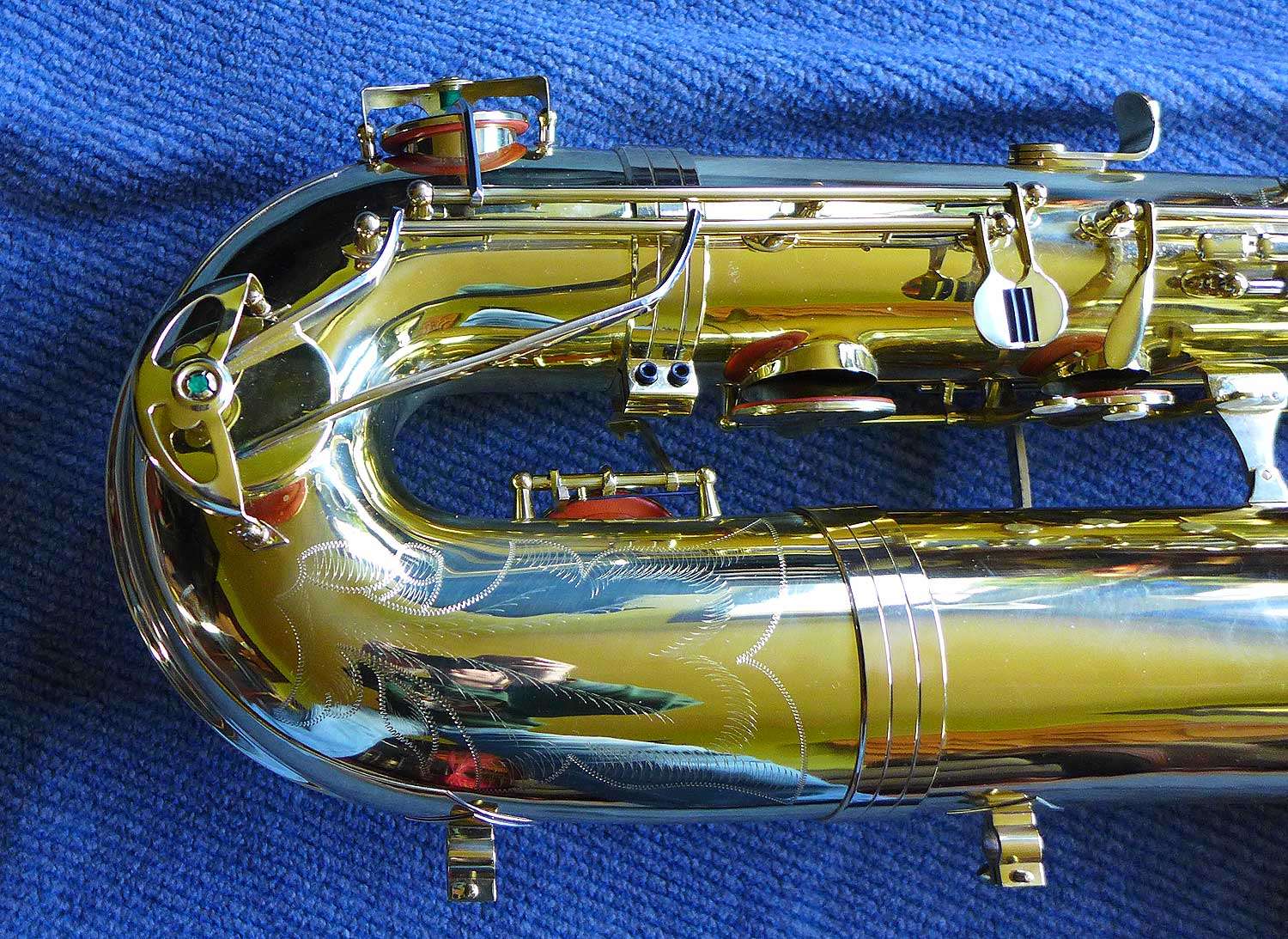
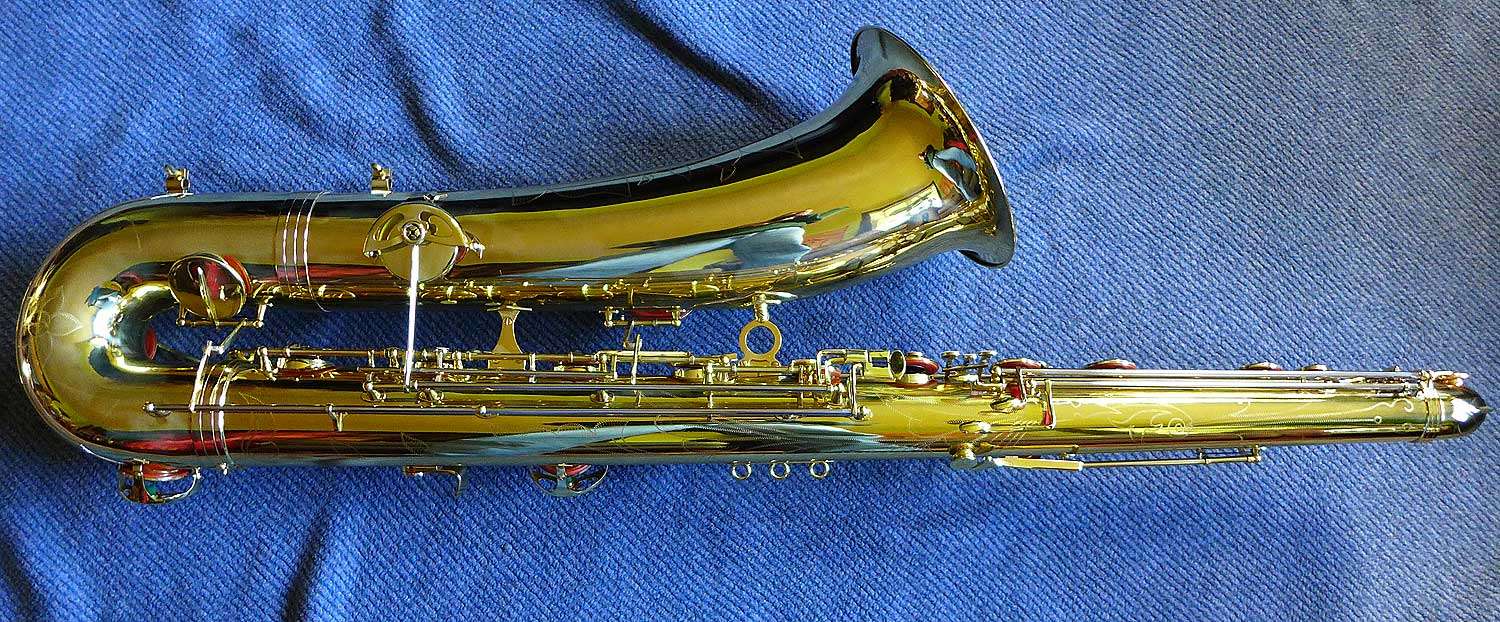
As can be noted in the photo on the left, the vintage American-style Jinyin bass saxophone has two bell to body braces. These heavy braces are stable, and prevent the heavy bell from gradually pushing its weight into the body tube when the instrument is carried in its case, or stored on its side. (Which is why the original cases had a support belt for the bell.) This is far superior to Buescher’s single brace, and at least as good as, if not better than Conn’s double X brace system that they introduced in their New Wonder Series II bass saxes.
Keywork differences vis-à-vis vintage horns
Upon looking carefully at this instrument, I noticed something pretty peculiar things, which might in fact contribute towards this XuQiu bass saxophone’s weight. If you compare/contrast this XuQiu bass saxophone to a vintage Conn or Buescher, you’ll notice some major differences in the key work that go way beyond the improvements already noted. Specifically, I’m referring to the key work in the upper portion of the body tube, the upper bow, and the long tube portion of the pigtail that connects to the upper bow.
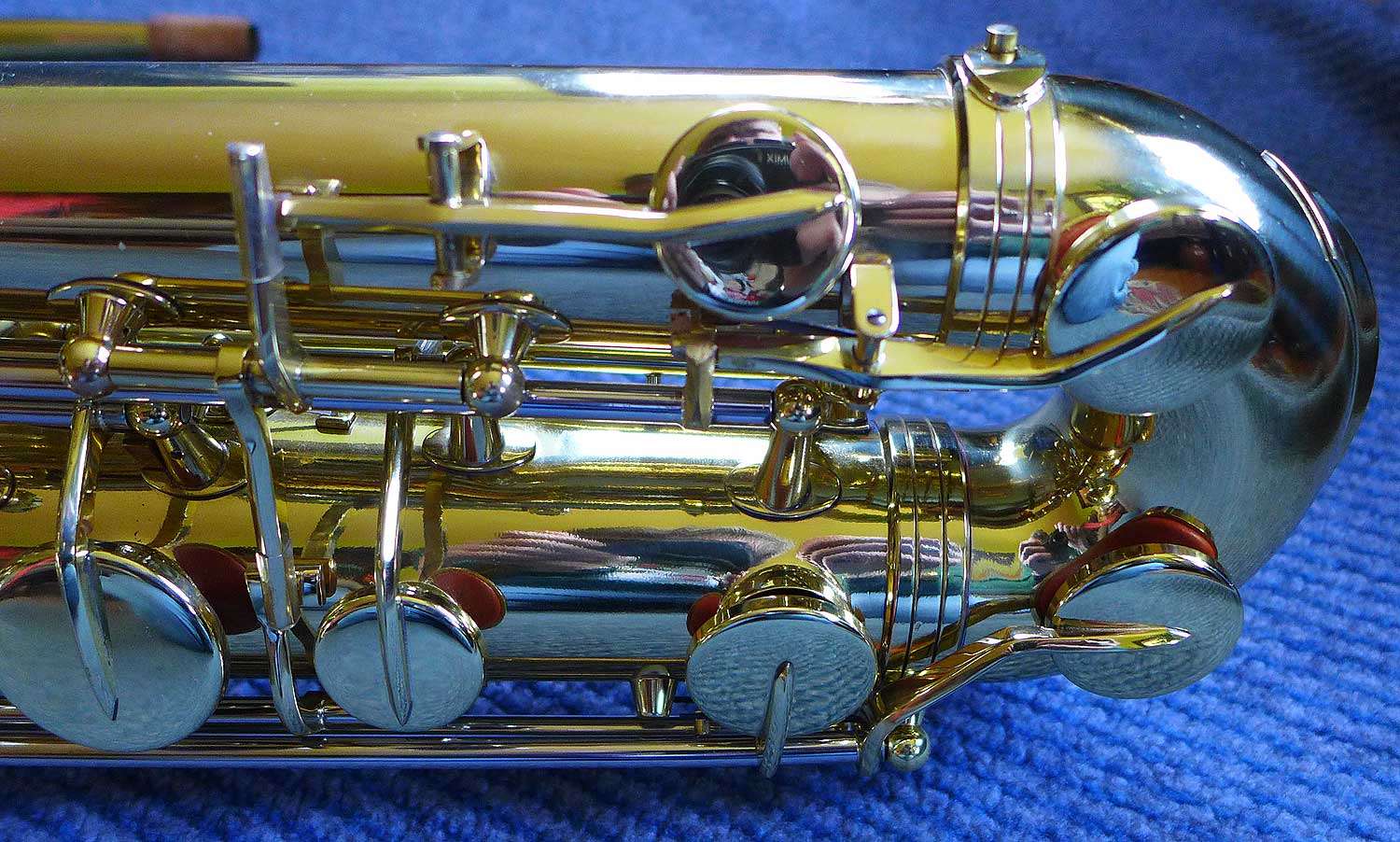
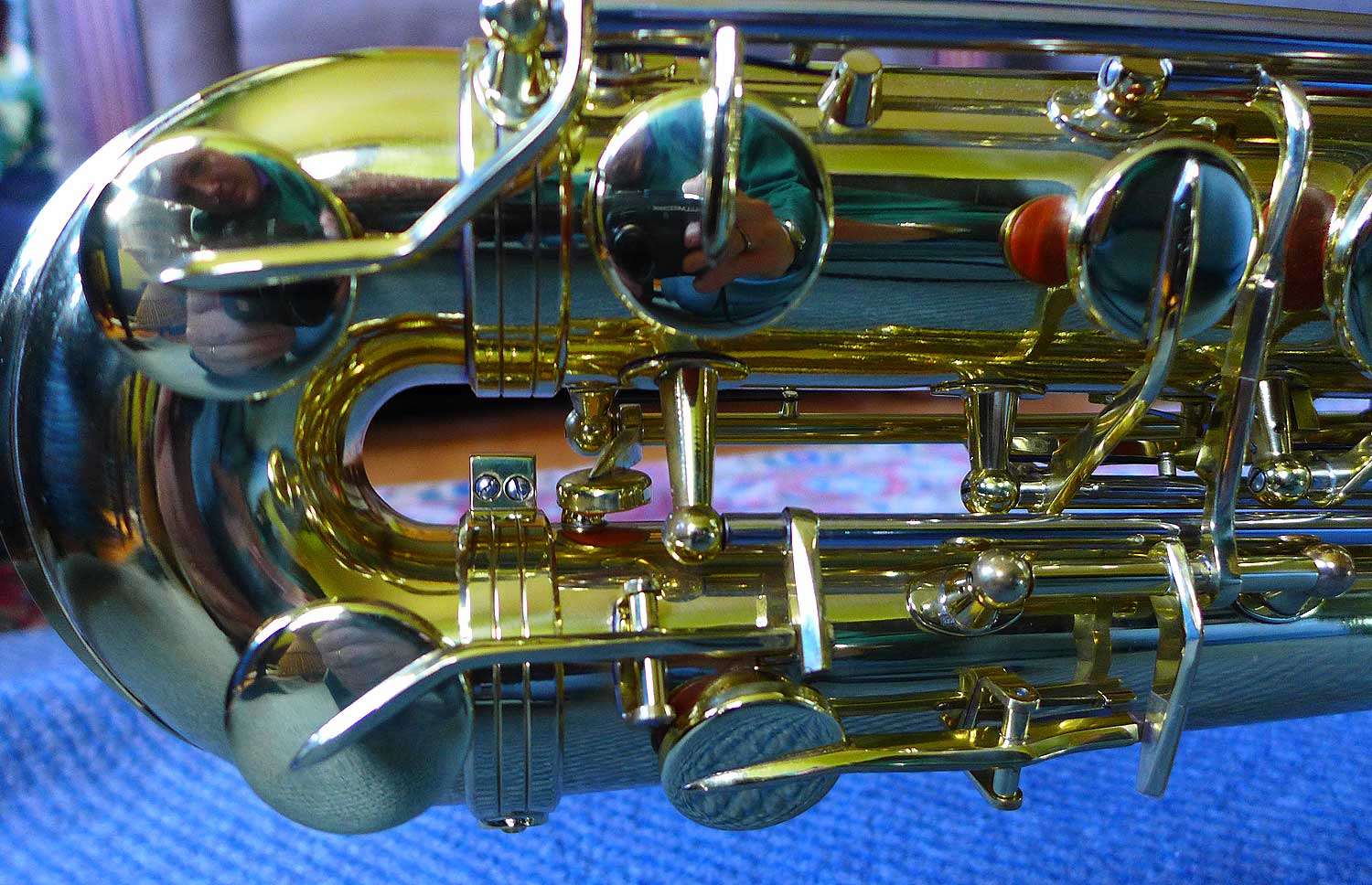
For those of us who don’t have a 14M keyed to high F, this key work looks rather odd. However, compared to the highly coveted 14M that Conn produced, it becomes obvious that the designers of this Jinyin-made bass sax borrowed from Conn’s design ideas with regards to key placement, but definitely not mechanics.

Jinyin doubled the key arms on the low C key. This is of course a great idea, but I would have liked to see them take it further and add double arms on more of the bell keys.

One thing I noticed, that could not be captured in photos, was the extra play there was on some on the keys. Despite the fact that this Jinyin-made bass sax had very few playing hours on it, it appeared that some of the keys needed swedging. However, this was not the case at all. The answer to what was wrong with this XuQiu bass can be found in repair tech’s Stephen Howard’s review of a similar Jinyin-made bass sax. This is what he says about the cause of this play:
…it’s that the rod screws are all 2.73mm in diameter…which is well within the normal range of rod screw sizes you’d find on saxes – but the key barrels are all drilled out to take a 2.9mm diameter rod screw. That almost a .2mm discrepancy, and while it doesn’t sound like a lot on paper I can assure you that in practice it makes a world of difference. The resultant gap between the rod and the barrel wall is that which you’d find on a very worn action – and that brings with it a whole host of problems…
There’s no way around these problems other than to ensure the action is as snug as possible on its pivots, and that they in turn fit snugly into the pillars – which means that every rod screw on this bass had to be upgraded.
While the existing rod screws were undersized, a 2.9mm rod fitted perfectly – so no additional drilling/reaming was required – but here’s the rub; I said there was no way around these problems, but the manufacturers had come up with an ‘ingenious’ solution, which was to put a slight bend in every key…and to knock the pillars slightly out of line with each other. It’s a clever trick, because the misalignment gives the appearance of well-fitting pivots – it’s only when you give the keys a bit of a jiggle, or actually try to play the instrument, that it all goes wrong.
I suspect that just like with the rollers, Jinyin used what they had in stock, and didn’t get special materials for their bass saxophones. 
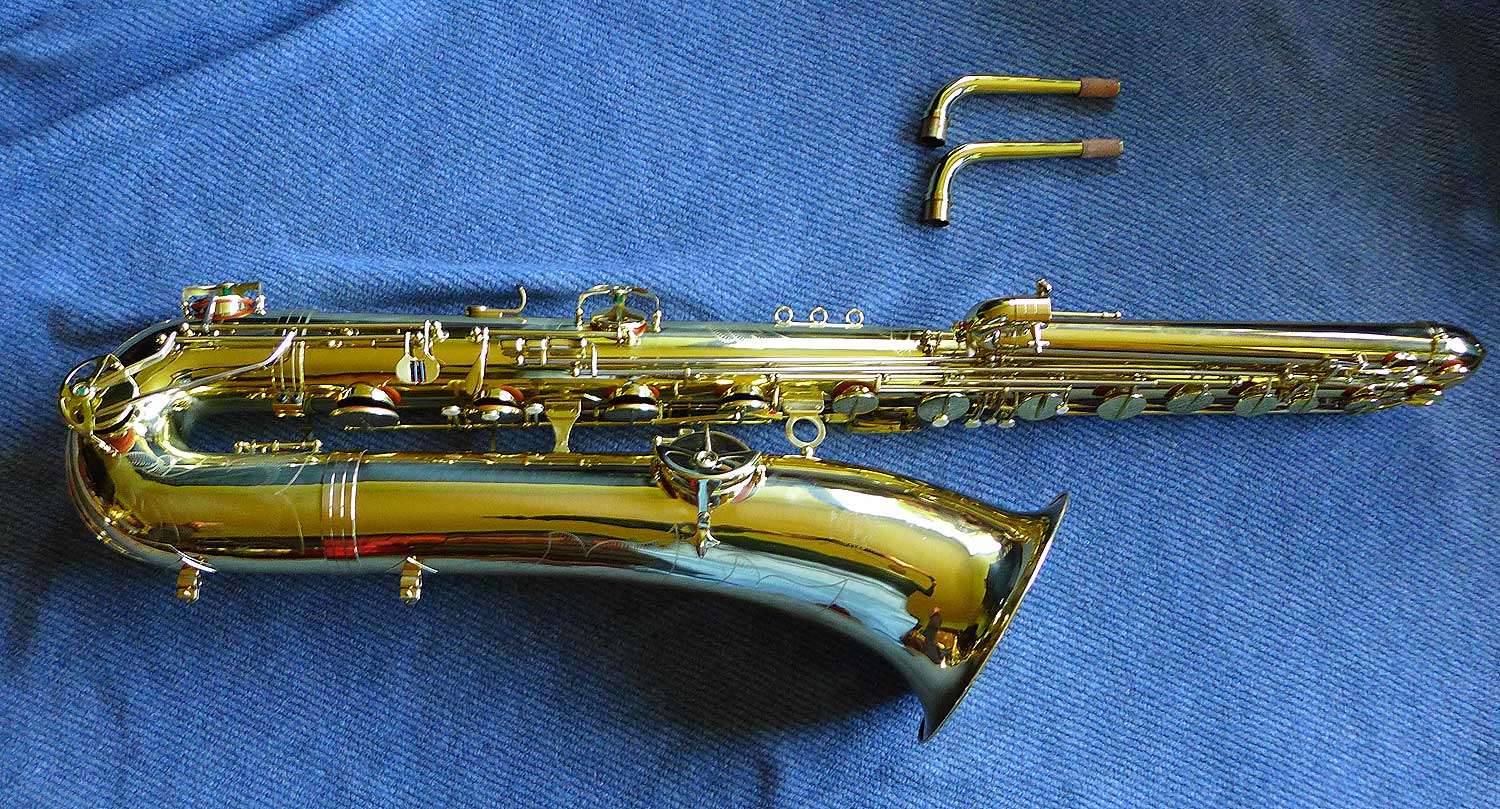
Some more pics of the Jinyin-made bass sax stencilled for XuQiu
The bottom line
Jinyin cut a lot of corners when they made their stencil bass saxophones. Remember, these are ultra cheap horns. A Conn or Buescher was built as a pro model instrument in its day. Julius Keilwerth still builds horns in this style. The SX90 bass lists for approx. 30K US in March 2026. When this article was first published 10 years ago, the SX90 was about ½ the price it is now.
The Jinyin-made bass sax, when sold new, originally ranged in price from $2,000 to $8,000 depending on what name was stencilled on the bell, and which online dealer you bought it through. There is no way that a cheaply made instrument is on the same playing field as one of its vintage predecessors in build quality. Period.
That said, this XuQiu bass did have a number of things going for it that made it easier to play than my vintage Buescher. Given how infrequently I play bass these days, I must admit, I was tempted by the horn for about a minute. Tick Tock. Time’s up.  Sure glad I came to my senses.
Yes, a cheap  Chinese bass is easier to play than a vintage American bass. So what.
Playing a vintage bass is a major workout. When I was playing and gigging with my Buescher True Tone I never had issues with it. However, once I stopped playing it regularly, I found whenever I did go to use it, getting used to it again was always a matter of getting into a certain head space. I basically had to toss away most things I knew about saxophone playing, and play the bass like it was its own instrument.
That’s what I appreciated about this cheap Chinese horn. I didn’t have to leave saxophone-land and enter bass-land. I could just play this Jinyin-made bass like I would any other saxophone. Sure, it needed a lot more air, but I could use my bis Bb fingering, and play up to high F without using altissimo fingerings.
For a casual bass sax player who plays 3 to 4 gigs a year, and is not putting the horn through heavy use, this Jinyin-made bass sax may well be a viable option. However, don’t expect to play it out of the box. (See comments below.)
Obviously the rods need to be replaced with the correct size. I would also have my tech go over it extremely carefully and fix all the problem areas. Maybe some levelling of the tone holes would be necessary. I would also have the rollers replaced with proper sized ones, and likely have the pearls replaced with real MOP. Key heights would also be set properly, since I suspect some on the intonation issues stem from there.
As for the pads with a mix of nylon and metal resos, I would have my tech replace the necessary pads to ensure the horn had the same style metal resos on all pads. But that’s just me, some players might not be that picky.
If you are seriously considering buying one of these horns, I strongly encourage you to read Stephen Howard’s review. As a tech, and not a bass player, he writes from a different perspective than I do.
March 2026 updated conclusion
The original review I wrote contained suggestions why the player who only plays bass occasionally, might consider one of these new Jinyin horns as a substitute for a vintage American bass, such as a Conn or Buescher, purely from an economic perspective. However, that just doesn’t hold true for a variety of reasons. They include:
- New, long wrap Chinese-made horns are no longer being sold by reputable dealers. (And no, Alibaba and Temu don’t count as dealers.)

- If you happen to stumble across a used, Jinyin-made long wrap bass, it simply doesn’t make sense to spend $$ buying such a used junky horn; spending upwards of 1K with your tech to address its shortcomings both Stephen and I address in our reviews; only to end up with a horn that is poorer in quality than a new, short wrap Jinbao bass through a dealer like Thomann.
- The short wrap bass saxophones have come down so much in price, it simply makes no sense to be tempted to buy a long wrap bass through a questionable site like Alibaba, when you can spend the same amount of $$ and get a much better sax from a well respected dealer, who offers a warranty. Period. End of statement.
Overall rating
The saying: You can put lipstick on a pig, but it’s still a pig,  certainly applies to these Jinyin-made, vintage American style bass saxophones. They are cheaply-made saxophones, and you get what you pay for. Although they might be easier to play than a true vintage American bass, they are NOTHING like them. Quite frankly, these horns are built so badly that they are pure unadulterated crap.
I have outlined many of the problems with them here, and Stephen has outlined more in his review.
For that that reason, I give this XuQiu bass saxophone by Jinyin a 1.5 out of 5 star rating.

Choices have expanded – A LOT
When the current bass sax renaissance first began maybe close to 20 years ago now, the Jinyin-made long wrap horns were far less expensive than the Jinbao-made, short wrap Selmer copies. The Jinbao horns were then selling for upwards of 10K US. Now, you can get stencils ranging the alphabet from A to Z, and for < 5K regularly, with a max price of around 12K for a customized horn from Music Medic.
As you can tell from my review of a Jinbao-made bass saxophone, they are not a 1:1 substitution for an actual pro horn—either new or vintage—but they are a damn sight better than these Jinyin ones. Will they stand the test of time like their vintage bass cousins made have? No, but then they cost a fraction of the price of a true pro horn, so you can’t expect them to be built like one.
When was the last time you saw a new Chinese-made, long wrap bass for sale?
Years ago a saxophone designer I respect told me that there were only 2 companies that manufactured bass saxophones: Jinyin & Jinbao. Now however, there appear to be at least 3, since P. Mauriat claims that they make their relatively new PM-350 bass themselves. Furthermore, it has literally been years since any of the companies that were offering bass saxophones with their brand name stencilled on the bell, had a long-wrap, Jinyin-made horn in the inventory, or even available for order.
Why? Most likely because the horns were such junk, and fraught with problems, that they had nothing but complaints. I can’t imagine a reputable business like Thomann having their name stencilled on a hunk of junk like this XiQiu bass I play tested in 2016.
These days, the only place where you’ll find these junky horns for sale are on highly questionable sites like Alibaba—which has more of these per square inch of computer monitor than you can poke your finger at. And only the best musical instruments come from sites like Alibaba, right?  But hey, at this point I feel like I’m beating a dead horse.
All I can do is advise you is NOT to buy one of new, long wrap bass saxophones through a hinky site that sells everything from counterfeits to toilet paper. If you do, that’s on you. You’ve been warned.
A long ago phone call with the designer, and his regrets
Many years ago I had the opportunity to spend an hour chatting with the designer who originally came up with the concept for both the long and short wrap horns we first saw pop up on our computer screens nearly 20 years ago. I am going to paraphrase a few key points he made about these vintage American-style, AKA, long wrap bass saxophones:
- They are junky.
- They are built on the cheap side by the factory.
- I really regret that they ever made it to market.
- I have stopped selling them through our store.
- If I am being brutally honest, I very much regret that I ever designed these things.
And yes, true to my word, I am still maintaining confidentiality about who that person is.
What my March 2026 research showed about these vintage American-style bass saxophones
1. Although I noted above that new ones no longer appear for sale on dealer websites or eBay, I did notice something peculiar when I updated the XuQiu bass sax link for this new article: Yup, the company still lists one for sale with a 20-30 day delivery time. But wait, there’s more… 
2. XuQiu also shows that they offer a short wrap bass these days. That in itself might not be so surprising if it weren’t for the next two points.
3. On their bass saxophone page, XuQiu offers the following info:
XuQiu’s saxophone series contains multiple sub-products. XuQiu pays great attention to integrity and business reputation. We strictly control the quality and production cost in the production. All these guarantee conn bass saxophone for sale to be quality-reliable and price-favorable. XuQiu cultivates a high-level and high-quality R&D and technical team. We are able to customize optimal solutions based on the differentiated needs. We provide high-quality OEM/ODM services.
If I am to understand this correctly, XuQiu does their own design (?) and manufacturing of these Conn-inspired bass saxophones.
4. Jinyin—who for years has been understood to be the manufacturer of the vintage American style bass saxophones—no longer shows bass saxophones in the product line at all.
Questions this new research leaves
- Has Jinyin ceased production of all bass saxophones?
- Does XuQiu indeed produce its own long-wrap bass saxophones?
- Does XuQiu also produce short models, or do they purchase them from Jinbao? Someone else?
I will be following up with these companies as I update the bass saxophone sections on this, The New Bassic Sax. Follow this site to keep up to date with my research findings.
