


Updated July 2026
I have a newly updated Dave Guardala® Saxophone page that focuses on the B&S-made DG horns. I have also include some brochures sent to me by a former dealer in Oslo that you might find helpful. If you are looking for info on DG horns, that should be a good jumping off point for you.
Introduction
If you love your Dave Guardala® saxophone and are looking for another one, or have heard such great things about the brand that you simply must try and get one of your very own, I have some very simple advice for you: Not all Dave Guardala® saxes are created equal.
Now I am not at all clear why sax players go crazy over these B&S stencils of their Series 2001, but over the last 25+ years I have learned nothing, if not that saxophone players are a fickle bunch.
Mouthpiece crazes come and go, as do horn fads. Certain horn brands are popular for a while, but then fade into near oblivion. B&S is one of those brands. For a while there everyone was talking about the B&S saxophones, but these days you can pick up most of their handmade, pro-model horns for less than a crap student or intermediate horn made in China or Taiwan.
One exception to these B&S bargain-basement priced horns, are the B&S-made Dave Guardala® saxes. Why this is has always left me scratching my head.  After all, DG horns are really nothing more than the Series 2001 with different engraving, right?
This is where the Dave Guardala® saxophone story becomes one of a horse of a different colour 
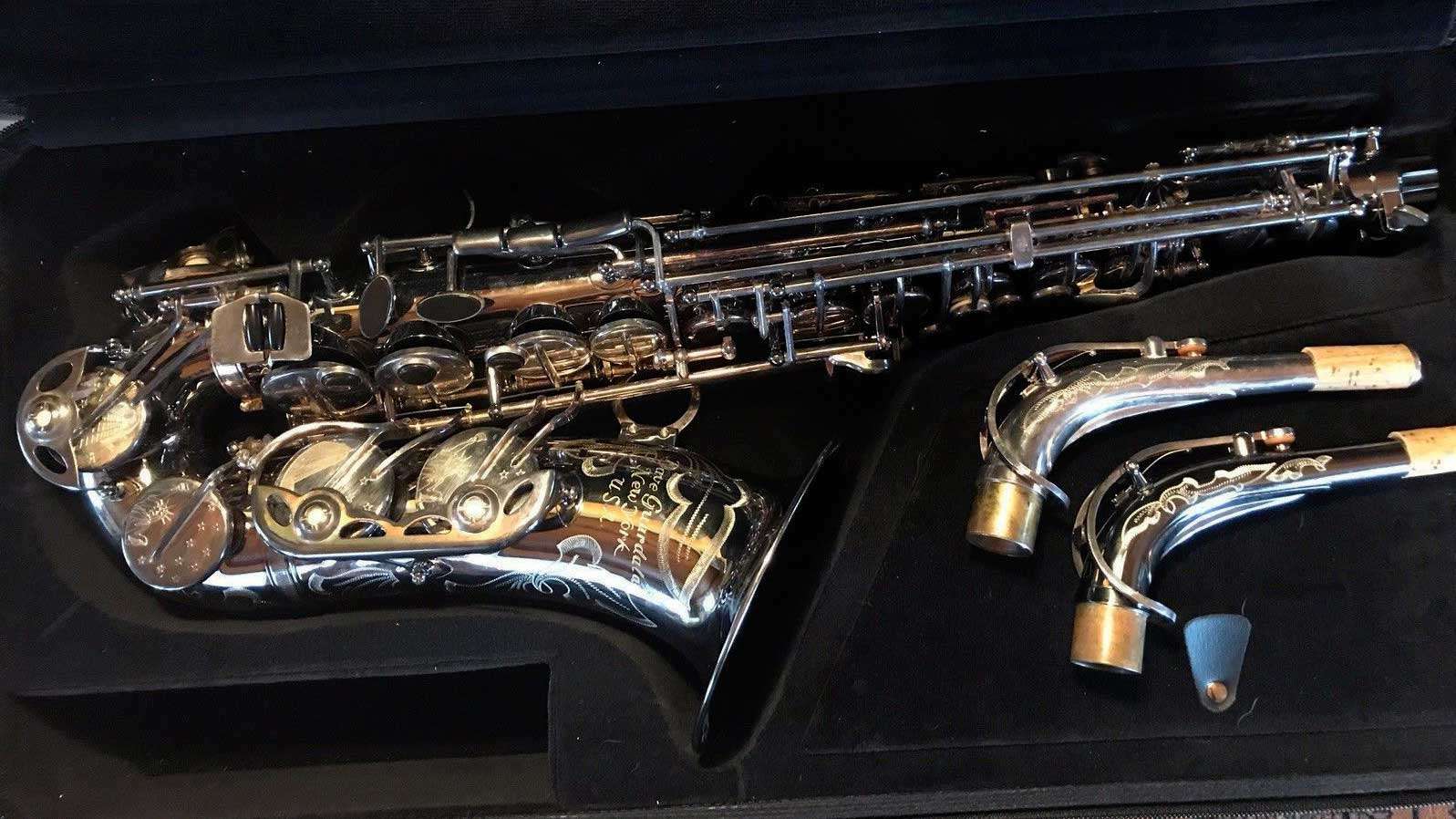
Shortly after I originally published the Dave Guardala page on the my original Bassic Sax website in 2016, I was sent photos of a DG horn that didn’t look at all like it was made by B&S. It certainly wasn’t a stencil of the Series 2001. The sax in question appeared to be either Chinese or Taiwanese in origin.

DTS-63BN #360230


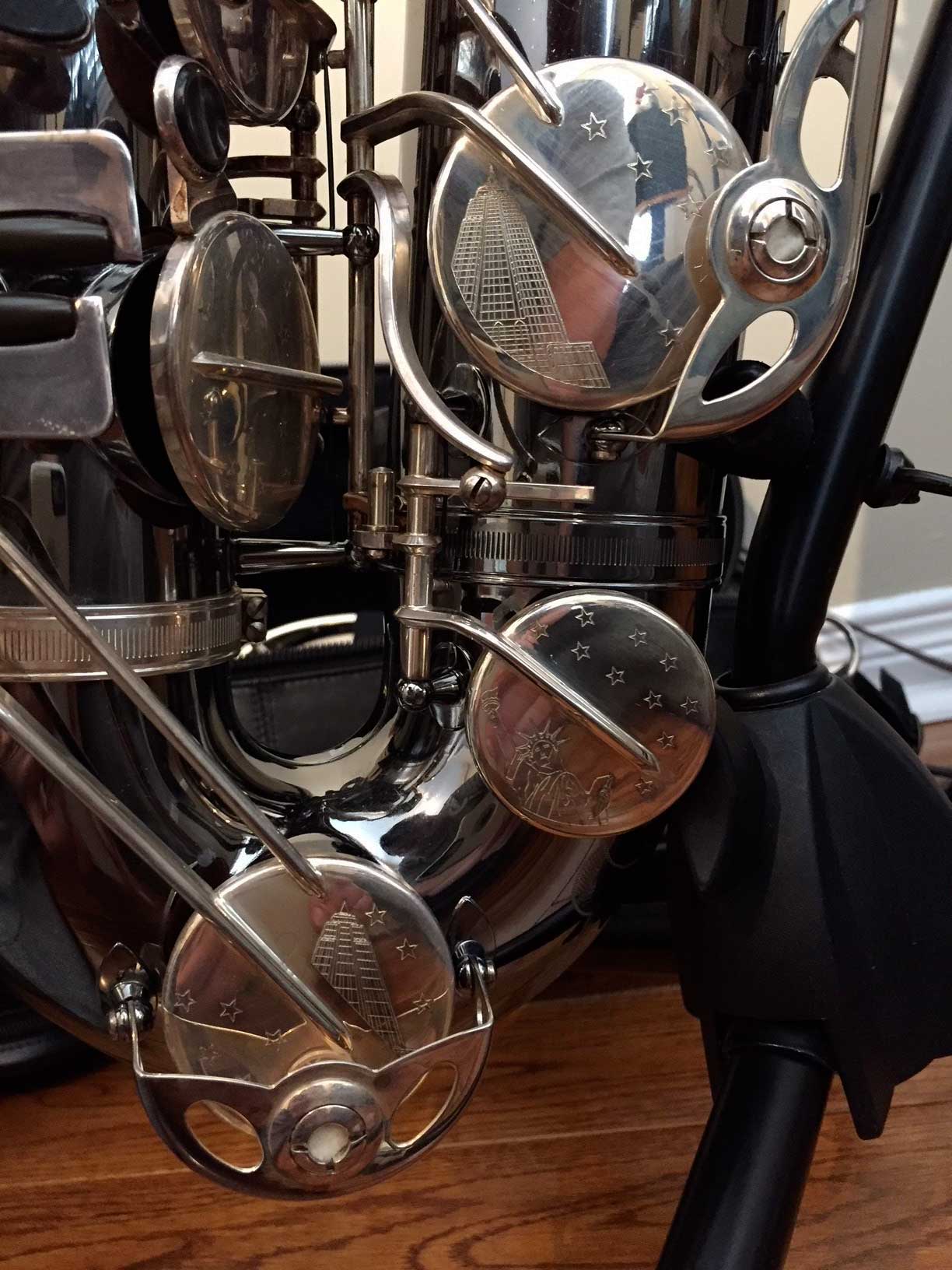


There are a whole host of points that allow you to distinguish a quality, B&S-made Dave Guardala horn, from a cheap, Asian-made one like that shown above. For a point by point comparison see the chart below, but for now a quick and dirty way to tell the difference is through the serial #.
A B&S-made horn starts with a “0” and has either 5 or 6 digits in it. It would look like: 0XXXX or 0XXXXX. Underneath the serial number is a stamp that says Made In Germany. Notice the direction that the serial runs on the body tube. Compare that the Asian-made horn shown above, and you immediately see the difference.
Until I saw the horn above, I hadn’t been aware of any Dave Guardala saxophones other than those made by B&S. My first thought was: Is this a counterfeit? DG is a pretty obscure brand to knock off, since its appeal is much more limited than say Selmer, Keilwerth, Yamaha, or Yanagisawa—brands we know are counterfeited all the time.
I posted a question to SOTW and asked if anyone had heard of Asian-made Dave Guardala horns. ATT the players who responded said that they maybe recalled that there were some stencils that Guardala ordered from Asian companies, and that those were sold through WWBW. However, that was so long ago they couldn’t say for sure any more when that even was.
I mostly forgot about these Asian-made DG saxes, until November 2018, when I received an email about the following alto sax that popped up for sale on eBay:

DAS-63BN #360761


The seller described this Asian-made Dave Guardala® alto saxophone like this:
Guardala black nickel plated, with silver keys, alto in beautiful condition. Historic NY landmarks and stars are etched on the key cups. Comes with two necks with matching serial numbers. The best part: it plays great and in tune. My research says it was made by VMI, a German company, which made these for WWBW, but I don’t see a stamp which validates that. Comes with brand new Keilwerth case. Really stunning and rare pro level horn.
I was tempted when I saw the ad, to write the seller and tell him/her that this horn was absolutely not a B&S-made sax. However, based on the description, I figured they already knew that. The seller just threw VMI in to confuse people, and the way the ad was written, it gave the seller an out in case a buyer ever discovered the truth about it not being German in origin.
IMO, alto #360761 is about as far away from a pro horn as an Audi is away from a Yugo. Just saying.
In case you’re wondering, this alto did sell. The seller got $1,225.00 US for the Asian-made DG alto.
Another finish for the Asian-made Dave Guardala® saxophones
One thing that both the alto and tenor shown above have in common is their finish. Both are ostensibly a black nickel plate, with silver plated keys. The only other finish I’ve seen these cheap, Asian-made DG saxophones in is a two-tone version of lacquer and silver. The bodies and keywork are lacquer, while the bell and neck are silver plated.
Back in 2018 when I wrote the first edition of this article, just a tiny bit of digging turned up the first example of this finish: it was an alto of unknown serial #. It was advertised on eBay in September 2018, and was said to have a nickel silver neck and bell.
However, unlike the previous seller who suggested a B&S connection, this particular seller was straight up about what they were selling though. There could be no doubt this was NOT a sax made by B&S.
NB: The photos that accompanied this auction were shite.  I did try to save as many as I could, but as the old photographer’s adage goes: Garbage in, garbage out.
Model & serial # unknown


This is how the seller described this Asian-made Dave Guardala alto:
NIckel [sic] Silver Neck and Bell. Brass body. It DOES NOT HAVE the “Made in Germany” stamped on the back. This is the last generation sold by WW&BW.
Recently repaded [sic] cleaned and adjusted by Scott Ankrom at South Florida Horns. The cost of the work done was $600.
It is not the B&S Guardala but is a great underrated horn.
Better and more flexible than many more expensive asian [sic] saxes in my opinion.
It has a big bold and crispy sound and it plays exceptionally in tune.
It can be really sweet as well.
The sound and feel is more Keilwerth than Selmer but it feels a little smaller than a Keilwerth under the fingers.
There is some rust on the lacquer of the neck (Pictures 8, 9,10 and 11) and a couple of scratches here and there but other than that the horn looks stunning.
It includes the original SKB case and shoulder strap. Both in great shape (not pictured)
Interestingly enough, this alto sold for $1,250.00 US. 
In July 2026, as I was researching Dave Guardala® saxophones further for The New Bassic Sax, I happened across another Asian-made DG tenor. This one is also in the two-tone finish shown above, but fortunately the photos are much better, and the model and serial are also captured in the photos.
DGNY1101 #360902


This is how jwsax described this DG tenor:
This Dave Guardala tenor saxophone is in spectacular condition and is ideal for the advancing student.
This is near to new and very beautifully made with its combination of silver plating and gold lacquer and extensive engraving including American themes on the key cups as shown.
To make sure it is playing at its best I brought it to Maestro Woodwinds in Brookline for setup work and it is playing at a high level and ready for serious use.
This saxophone comes in an SKB brand hardshell contoured case that offers excellent protection.
And yes, this horn was sold, so we don’t know what the asking price was.
What these horns all tell us, is that regardless of the finish, when looking for a Dave Guardala® saxophone, you have to be careful.
So how can you tell a German-made Dave Guardala® saxophone from one made in Asia?
Dave Guardala® horns from B&S came in a number of different models, but the ones that sell for the most money, the most consistently, are the New York Series™ Models. Why? Don’t know.
Perhaps the Twin Towers engraving allows players to express their patriotism. Conversely, perhaps some people are just ghoulish.  Regardless of the reason, DG knew his B&S New York Series™ was the most popular, which is why the Asian-made saxes bearing the Dave Guardala™ name are covered in New York skyline engraving—regardless of the model.
The cheap, Asian-made DG horns I have seen to date are all engraved in the style of the original B&S New York Series™. However, the engraving itself is a cheap imitation of the original hand engraving. Samples are included in the chart below.
There are a lot of tells when it comes to distinguishing a B&S-made DG sax from Asian-made one. These include:
B&S-made Guardala |
Asian-made Guardala |
|
Key arms to low C, B, & Bb |
||
Shape of right pinkie keys |
||
Key touches |
||
Serial # location & direction |
||
Engraving |
||
Bell to body brace |
||
Key Guards |
||
Bell Engraving* |
||
Pant Guard |
||
F# Key Guard & Right Thumb Rest |
Not like those from B&S. Side by side you can see the difference. |
* The bell engraving on the Asian-made horn is the same in text as what B&S PUT ON THEIR NON-NEW YORK SERIES™ HORNS. However, the Asian horns are engraved in the New York style. That’s a big tell.
What this compare/contrast of the German vs. Asian-made Dave Guardala® horns tells us
If you took a careful look at all the photos I linked to in the chart above, you should likely have come to the same conclusion that I did: the Asian-made Dave Guardala horns just look cheap in side by side comparisons to the German-made B&S horns. Furthermore, nothing in my experience has given me any indication that these Asian-made horns will be as good as the B&S saxophones that carry the Guardala name.
Now I freely admit that I have not played a DG sax made either in Germany or Asia. I have however, owned a B&S Medusa, and I have played many current production model horns made in Taiwan and China. Quite frankly, there simply is no comparison.
That said, if you own or currently play a horn made in Asia, and really like it, I’m glad for you. Not everyone has to like the same thing. And Asian-made horns do fall along a continuum. Some are very good, while others just simply suck beyond words.
So what was the point of all this?
This article is aimed at distinguishing the differences between the two kinds of Dave Guardala horns, and assisting potential buyers of these used horns, to make sure that they in fact get what they are looking for, and not over paying.
I am not sure why Dave Guardala had his horns made in Taiwan or China after his relationship with B&S ended. I guess it’s the same reason why everyone else does these days: there are simply no saxophone companies left in Europe that will make stencils—at least at a price that is half way affordable.
Unfortunately, by going to the Far East for his stencil horns, Guardala really created a lot of confusion for potential buyers. Another possible explanation for this stencil source is that he had nothing to do with these horns at all.
Perhaps WWBW ended up with the rights to the Dave Guardala name for stencils. Maybe they just ordered these horns from Asian companies just like they did with their own Allora brand, after B&S ceased saxophone production.
This is of course pure speculation on my part, and I have no facts to back it up, but it might explain why someone who is known for extremely good, premium mouthpieces, and developed a great reputation for his horns, would jeopardize that name by going to a cheapened version of his saxophones.
Or maybe he just had to pay his legal bills. 
