


Updated 2026
Company History
As became the norm in Eastern Bloc countries, the VEB Sächsische Musikinstrumentenfabrik was established in 1946, through the expropriation of a private firm—in this case, the Ernst Hess Nachf company.
Under the VEB Sächsische Musikinstrumentenfabrik name, the VEB—meaning Volkseigener Betrieb, see below for English definition—produced musical instruments between 1946 – 1952. The saxophones built by the Sächsische Musikinstrumentenfabrik were sold under the name Akustik.
On January 1, 1953, the Sächsische Musikinstrumentenfabrik merged with the Signal-Instrumenten-Fabrik Markneukirchen, and the Vogtländische Etuifabrik Adorf. The merger of these 3 VEBs created the VEB Blechblas- und Signal-Instrumentenfabrik, more commonly known as B&S.
NB: Since there are no serial # records, it is really impossible to know when the Sächsische Musikinstrumentenfabrik-made Akustik ended, and when the B&S-made Akustik began. I have also not come across anything that says with authority whether or not B&S restarted the serials when they took over saxophone production.
Why does this matter?
Simply put: Because it’s important to understand the history of the instruments we are looking at. Akustik the first step in a long and winding stairway that will ultimately lead to the Dave Guardala and Medusa saxophones of the 90s and early 2000s.
Akustik saxophone time line
When |
What |
Location |
1946 |
E. Hess Nachf. was expropriated and the company known as VEB Sächsische Musikinstrumentenfabrik was established. |
Klingenthal |
1946 |
The saxophone department was located in the factory that used to belong to Max Bernhard Martin |
Markneukirchen |
1948 |
Alto sax production commenced under brand Akustik |
Markneukirchen |
VEB Sächsische Musikinstrumentenfabrik did not have the capabilities to make the bells, so it outsourced to William Voigt |
Markneukirchen |
|
1950 |
Tenor saxophone production began |
Markneukirchen |
1951 |
Akustik soprano and baritone saxes advertised |
Company brochure early 1951 |
============================================== |
============================================== |
============================================== |
Jan. 1, 1953 |
VEB Blechblas- und Signal-Instrumentenfabrik, AKA, B&S, is created through the merger of: Sächsische Musikinstrumentenfabrik; Signal-Instrumenten-Fabrik Markneukirchen; and the Vogtländische Etuifabrik Adorf. |
|
Oct. 22, 1958 |
Weltklang trademark application applied for |
|
1958 |
First iteration of Weltklang log used |
Print ads throughout the Musikwinkel and Klingenthal areas |
1966 |
Weltklang offered: soprano, baritone, as well as 3 models each of altos and tenors |
|
1966 |
Altos and tenors included the Soloist model with 13 MOP key touches. This model was dropped when B&S was introduced. |
|
1969 |
All saxophone production had moved to its new factory |
Klingenthal |
1969 |
Hand craftsmanship now replaced by increased industrial production |
Klingenthal |
Getting back to Akustik
Starting in mid 1948, the Sächsische Musikinstrumentenfabrik had 20 employees, lead by Anton Röhlig 1, build their alto saxophones—which were branded Akustik. However, the factory did not have the ability to produce bells in its production facility, so chose William Voigt from Markneukirchen as the interim supplier of saxophone bells. 2
In 1950, the VEB began manufacturing tenors as well. Until the VEB’s merger to form B&S in January 1953, approximately 2000 altos and 2500 tenors were made. After the creation of VEB Blechblas- und Signal-Instrumentenfabrik, Akustik production continued until the beginning of the 1960s. The brand was then replaced by Weltklang.
Although the Sächsische Musikinstrumentenfabrik advertised a full line of SATB line of saxophones in a 1951 brochure 3, there is no evidence that Akustik-branded soprano and baritone saxophones were ever made. Once the Weltklang saxophones were introduced, that is when we first see a full SATB line of saxophones offered.
Akustik saxophone features
Key touches & rollers
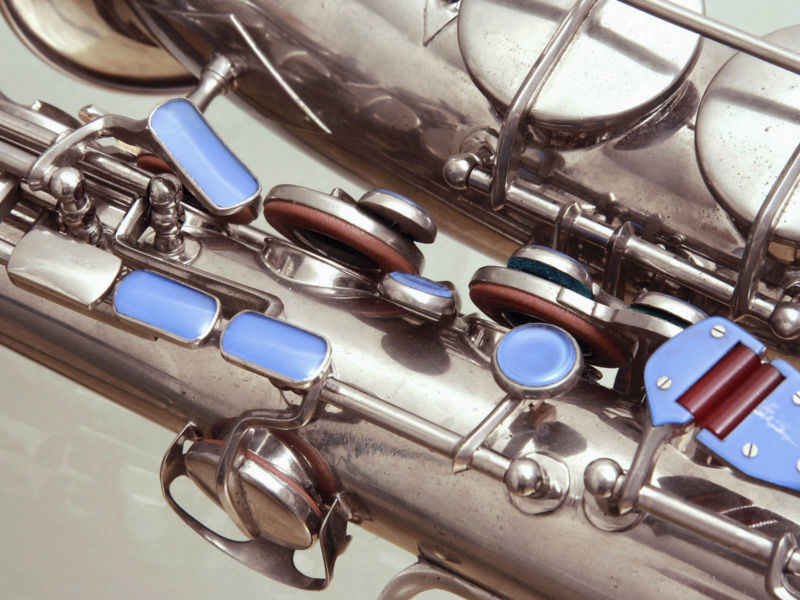
- The first thing that jumps out at you when you see one of these Akustik saxophones is the coloured glass or plastic key touches the brand originally came with.
- Dark amber is the most common colour we see, although blue and bright orange were seen as well. (Especially in the full pearl models.)
- When the original amber touches fell out, white replacements can be seen in the horns we find online.
- Notice the variation in roller colours as well.


“Full pearl” models
- I have seen only a few Akustik saxophones with full pearl—or more likely full glass or plastic—key touches.
- Those that I have, were either light blue or orange.


Extra keys
All Akustik saxophones I have catalogued came with the following additional keys:
Left pinkie cluster
- Another thing that is rather unique about Akustik saxophones, is the shape of their left pinkie clusters.
- It is shaped very much like that of the early Weltklangs.
- Here is a full pearl Akustik for comparison. (Read: the design wasn’t changed when the Weltklang were first introduced.)
Low C mechanism
- If you’re familiar with saxophones from the Germanic regions of Europe at all, these right keys will look 100% familiar to you. Literally every brand and stencil from A (Akustik) to Z (Zenit) had this same shape. And yes, Weltklang will inherit this right pinkie cluster.
- On these Akustik horns you can see that the alto has both the Eb & C keys attached on the same 2 posts.
- Whereas on the tenor has the Eb key on separate posts from the low C key.


Post to body construction
- Akustik saxophones are built using post to body construction. This means rather the posts are soldered to the body directly.
- This is something that German saxophones continue to this day. The Keilwerth SX90R are an example of pro horns that still use this type of construction, rather than the heavier, ribbed style common in Selmers.
- Fun fact: the final evolution of the Akustik, the B&S Medusa that was discontinued circa 2005, and signaled the end of saxophone production for the company, utilized ribbed construction.
Microtuner
- By far and away the majority of the Akustik saxophone necks appear to have a microtuner. Alto or tenor, both have this feature.
- 100% of altos I have catalogued have a microtuner, but there are a couple of tenors I have stumbled upon that break the microtuner rule. Perhaps these are replacement necks? Possible. We will likely never know.
- Also note I have seen a couple of examples of tenors with microtuners and pickups. What is especially interesting is that on tenor #1296 & 1494 the serial # on the neck match that of the sax.


Engraving
As described below, there are a lot of variations in the hand engraving done on Akustik saxophones—both before and after the creation of B&S. To see the various engraving samples, check out the Akustik galleries on Bassic Sax Pix.
Bell to bow connecting ring
The connecting ring on the various Akustik saxophone saxophones I have collected images of over the years contain a variety of engraving. Unfortunately, since many horns don’t have this feature shown, or shown in its entirety—or even in focus—the listing is far from complete.
That being said, the engraving on the bell to bow connecting ring varies from none at all, to:
- XXX Mus.-Instr.-Fabriken/Klingenthal (alto #16xx)
- Sächs. Musikinstr. Fabr. Klingenthal (tenor #1329) Sächs. engraved on the bell just above the connecting ring.
- Sächs. Musikinstr. Fabr. Klingenthal SX V.E.B. ? (alto #2046) Sächs. engraved on the bell just above the connecting ring.
- xxx Musik.V.E.B (alto #2631) *
- Sächs. Musikinstr. Fabr. Klingenthal -Sa. V.E.B (tenor #1296) Sächs. engraved on the bell just above the connecting ring.
- XXCHS.-MUSIK. V.E.B (tenor #5386) *
* I suspect this one was made before the formation of B&S in 1953.
Bell engraving
- The bell engraving on Akustik saxophones was all done by hand, and varied greatly over their production run. The ranged from very basic, to incredibly ornate. The most ornate appear on the altos and tenors produced after the creation of B&S, and even had their bows engraved.
If you are interested in seeing what the engraving looked like, make sure you check out the Akustik galleries on Bassic Sax Pix.
Rolled tone holes
- All Akustik saxophones have rolled tone holes.
Key guards & right-sided bell keys
- Except for 1 exception—Akustik alto #? immediately below—all Akustik saxophones have wire key guards.
- Despite their old-school wire key guards, all Akustik altos and tenors had right-sided bell keys.
Akustik alto #?
This horn is quite the enigma. In December 2011, a well known vintage saxophone dealer from Germany had this Akustik alto listed on eBay. He wrote the following about it.
Old saxophone from AKUSTIK.
These instruments were manufactured in 1952 and 1953. Please take a look at the pictures first. The instrument is like new, with only minimal signs of wear.
…and it plays that way too, with easy response and a great sound, naturally, in the old German saxophone-making tradition, with rolled tone holes, G-sharp trill, D-sharp trill, mother-of-pearl inlay on the G-sharp lever, F-lift and mircrotuner.
Source: bluespeter1 on eBay.de


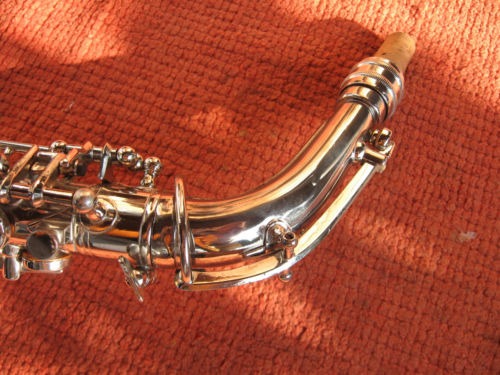
- The sheet metal key guards are not seen in the Weltklang altos until much later in the horn’s evolution. Why did this Akustik alto have them? No clue.
- To date it is the only Akustik saxophone I have seen that does not have wire key guards.
Finishes I have catalogued
I have not seen any brass finish Akustik altos and tenors. Only variations of:
- Variations of silver plate
- German silver nickel plate
- Silver plate with gold wash bell
Check the Akustik galleries in Bassic Sax Pix to see what these finishes look like.
Early Weltklang saxophones
As the Akustik model evolved into Weltklang saxophones, the earliest altos and tenors often sported the coloured key touches from their predecessors. Presumably B&S was using up old stock. For example, here is Weltklang alto #3634, which sports those orange key touches and rollers.

Serial # range
A couple of points to keep in mind:
- There is very little written about this brand in either books by German sax historians, or on reputable forums/websites by specialists who have made it their vocation studying instruments from this time period. Therefore this leaves us with a fair amount of questions regarding this rather unusual, and somewhat obscure saxophone that predates & sometimes overlaps B&S.
- I have NEVER come across any references to serial numbers, or hints at when horns with certain serials may have been made.
- I am also not clear if B&S restarted the serials at some point after they took over the VEB Sächsische Musikinstrumentenfabrik in 1953. Based on the engraving on bells, I suspect B&S may indeed have restarted their serials when they moved their saxophone production to Klingenthal.
To date, these are the serials I have seen on the alto and tenor Akustik saxophones I have catalogued
Lowest # |
Highest # |
|
Alto |
16xx |
3749 |
Tenor |
1296 |
1 Faszination Saxophon, Günter Dullat, 2016, Special Exhibition held by the Musikinstrumenten-Museum Markneukirchen, p. 242
2 Faszination Saxophon, Günter Dullat, 2016, Special Exhibition held by the Musikinstrumenten-Museum Markneukirchen, p. 218.
3 Faszination Saxophon, Günter Dullat, 2016, Special Exhibition held by the Musikinstrumenten-Museum Markneukirchen, p. 242
Dr. Enrico Weller commenting on the Forum des Musikinstrumentenmuseums Markneukirchen.
Uwe Ladwig, in der deutschen Fachzeitschrift—German music journal—SONIC sax & brass.
I would like to thank Uwe for so generously allowing me to use his research, and very much appreciate the trust he has shown by allowing me to do my own translation.
Volkseigener Betrieb (VEB) was the legal form of an industrial enterprise in East Germany. They were publicly owned and were routinely combined with other organizational units called Kombinate. The English term for a VEB would be people-owned enterprise, or literally, National Corporation.
Source: The Free Dictionary
